Freelance labor - Risks and disadvantages

ĐBP - No contracts, no insurance, and no benefits in case of a work “accident” are what can easily be imagined for freelance workers. What’s concerning is that the nature of freelance labor involves hard work, unstable income, yet few people care about workplace safety or occupational diseases. The consequence is that this group of workers often finds themselves trapped in a cycle of risks and disadvantages.

For the sake of “making a living”

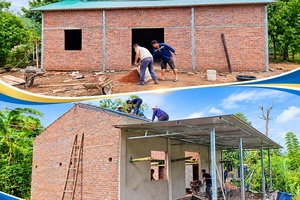
At a housing construction site in the Noong Chứn area, Nam Thanh ward, Điện Biên Phủ city, Điện Biên province, witnessing workers hanging on shaky scaffolding, some building, some plastering, some throwing bricks... all without protective clothing, no safety nets around, we could begin to understand the hardships, exhaustion, and even the dangers faced by freelance workers.

Stepping out of a pile of cement, bricks, and dust, drenched in sweat, Trần Duy Tuyên, residing in Thanh Luông commune, Điện Biên district, who has nearly 20 years of experience as a construction worker, said: “When we take on a project, we just dive into work to earn money. No one teaches us about workplace safety, and we are too busy to attend any training, mainly just exchanging tips among us to reduce risks, especially when working at heights. For protective gear, gloves and a helmet are about all we have.”

A freelance worker on a precarious scaffold at a housing construction site in Noong Chứn hamlet, Nam Thanh ward.


Building houses, construction of technical works, mining, assembly and electrical mechanics, and simple labor in agriculture... these are some of the occupations where many freelance workers participate. They work hard, facing constant risks from their jobs. However, most of them must accept the reality of working without contracts, no insurance, and no training on basic labor safety, not even safety equipment.

The indifference towards ensuring occupational safety and hygiene from both the workers and employers is one of the main causes of work accidents. Statistics on work accidents among those working without contracts in the province show that in 2024, there were 11 work accidents, leading to 6 deaths and 5 serious injuries. Among them, simple work accidents in agriculture accounted for 4 cases, and simple labor in house construction accounted for 7 cases.

Work accidents are something no one wishes for, but when they happen, in addition to the damage to health, freelance and temporary workers without binding contracts find it difficult to claim related benefits. In fact, because most freelance workers work without contracts, when an accident occurs, the authorities cannot track it since neither the employer, nor the worker reports it.

For example, in the accident report for the province, it was shown that in 2024, communes and towns did not report fatal work accidents involving workers without contracts to the authorities as required; they did not prepare records or report the incidents to the district, town, or city where the accident occurred, especially in cases of serious injuries. This has made it difficult for the authorities to protect the workers’ legitimate rights.

More practical “support” needed

In recent years, the government has implemented several policies aimed at freelance workers. For instance, voluntary social insurance and universal health insurance have allowed freelance workers to receive healthcare, pension, and death benefits. More practically, the Law on Occupational Safety and Hygiene clearly states that workers without contracts have rights such as being protected by law to work in safe conditions and being trained in safety and hygiene when doing high-risk jobs. In addition, freelance workers are allowed to participate in and benefit from voluntary work accident insurance, with the government providing support for the contribution rates...

Simple labor in construction is a profession that frequently experiences workplace accidents.

Many policies are in place, but very few freelance workers participate in them. This is mainly because of a lack of awareness among many freelance workers who do not see the benefits, and because of their difficult economic conditions, low incomes, and unstable jobs, they are generally not enthusiastic about these policies.

Lò Văn Thường, a freelance worker from Mé hamlet, Thanh Hưng commune, Điện Biên district, working as a bricklayer on a construction site, said: “I also want to buy insurance to protect myself, but the money I earn does not even cover my daily expenses, and the income is unstable. I cannot afford to pay for insurance since it requires a long-term commitment. Many times, my colleagues have had accidents like falling off scaffolding or being hit by bricks or steel... Thinking about it scares me, but I still have to work to earn a living.”

Given the reality described above, it is clear that more practical and effective solutions are needed to help freelance workers easily access and benefit from existing social welfare policies. Additionally, it is essential to strengthen inspections of the businesses employing freelance workers to identify violations and address them in a timely manner. Freelance workers themselves also need to protect themselves through various means, with understanding social insurance policies being crucial in protecting themselves before agreeing to work for any organization or unit.

Thu Hằng
Comment

You have 500/500 characters left

Please enter 5 or more characters!!!

Recent news

  • 'Clearing way for resettlement along expressway project

    Clearing way for resettlement along expressway project

    ECONOMY -
    ĐBP - To support construction of the Sơn La-Điện Biên-Tây Trang border-gate expressway, Điện Biên province is stepping up land clearance and the construction of resettlement areas and sites. In Mường Lạn and Mường Phăng communes, land has been handed over at resettlement sites, enabling contractors to begin construction.
  • 'Building strong grassroots-level governance

    Building strong grassroots-level governance

    NEWS - POLITICS -
    ĐBP - Within the two-tier local governance model, building strong grassroots-level governance is a crucial requirement to elevate the validity and efficiency of management, administration, and the quality of serving the people.
  • 'Applying technology to leverage value of historical monuments

    Applying technology to leverage value of historical monuments

    TRAVEL -
    ĐBP - Điện Biên is a land rich in historical tradition, preserving the heroic vestiges of the Điện Biên Phủ Campaign alongside numerous valuable cultural heritages. Amidst digital transformation, technology applications are progressively innovating operations at the Điện Biên Phủ Museum, contributing to elevating the efficiency of managing, conserving, and promoting cultural heritage values.
  • 'Unleashing strength from the people

    Unleashing strength from the people

    NEWS - POLITICS -
    ĐBP - In every village and hamlet of Điện Biên, the power of solidarity is awakened through concrete models and deeds, promoting the active subject role and cooperative spirit of the People in building an increasingly rejuvenated homeland.
  • 'Helping OCOP producers break into bigger markets

    Helping OCOP producers break into bigger markets

    ECONOMY -
    ĐBP - Markets are expanding, but expectations for products are becoming more demanding. Alongside quality, consumers and distributors are paying closer attention to product origins, production processes, packaging, labeling and the ability to maintain a stable supply.
  • 'Accelerating progress of production development support

    Accelerating progress of production development support

    ECONOMY -
    ĐBP - From the operational capital of national target programs, Điện Biên province is deploying hundreds of production development support projects, contributing to expanding flagship crop zones and generating livelihoods for poor and near-poor households.
  • 'Listening to residents, building consensus in Si Pa Phìn

    Listening to residents, building consensus in Si Pa Phìn

    NEWS - POLITICS -
    ĐBP - From everyday concerns to local policies and initiatives, residents of Si Pa Phìn commune are increasingly able to contribute their opinions, express their aspirations and monitor implementation. By proactively listening, making information public and working together to address legitimate public concerns in a timely manner, local authorities are making grassroots democracy more meaningful and fostering consensus on local development.
  • 'Transmitting heritage through community classes

    Transmitting heritage through community classes

    CULTURE - SPORTS -
    ĐBP - The preservation of cultural heritage in Điện Biên is being carried forward through community classes and daily transmission activities in hamlets and villages. Driven by the dedication of artisans and culture bearers, alongside the proactive spirit of learners, traditional folk songs and dances are transmitted, contributing to safeguarding ethnic identity and ensuring the vitality of heritage within community life.
  • 'Preserving beauty of ethnic minority costumes in Na Sang

    Preserving beauty of ethnic minority costumes in Na Sang

    CULTURE - SPORTS -
    ĐBP - Along with their languages and scripts, the traditional costumes of ethnic minority groups reflect customs, traditions and aesthetic values, while preserving knowledge and skills passed down through generations. In Na Sang commune, efforts to maintain embroidery and tailoring traditions, together with classes teaching traditional pattern-making techniques, are helping preserve the cultural identity of local ethnic communities.
  • 'Nà Hỳ restructures crops

    Nà Hỳ restructures crops

    ECONOMY -
    ĐBP - From swiddens cultivating corn, rice, and cassava on steep land, the people of Nà Hỳ commune are gradually shifting to planting coffee, macadamia, and several perennial industrial crops of high economic value.