Spring comes to Sán Chay people

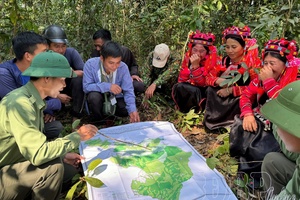
ĐBP - Ahead of the 2025 Lunar New Year (Tết) holiday, a visit to Huổi Thanh 1 Hamlet, Nậm Kè Commune, Mường Nhé District, reveals the changes of the Sán Chay ethnic minority people as their community gradually develops.

From a poor hamlet where Sán Chay people had struggled with daily hardships, the small hamlet has a new appearance. It now has fertile rice fields, lush cassava fields, and new stilt houses with bright smiles on the faces of the Sán Chay people who are busily preparing for a cozy and joyful new spring, reflect the profound changes in their lives.

Sán Chay women making traditional costume.

The road leading to Huổi Thanh 1 Hamlet, about 12 kilometers from the center of Nậm Kè Commune, has changed significantly. From a winding road which was dust in sunny days and mud in rainy days, it was recently concreted and widened, making transportation become safer and more convenient for local people.

According to Head of Huổi Thanh 1 Hamlet Đặng Văn Néng, the area is home to 98 families with 546 residents who are from three ethnic minority groups including 38 Sán Chay, 38 Dao, and 22 Mông households. Although the poverty rate is about 40%, the Sán Chay community here has fewer households living in poverty, most are classified as near-poor instead.

Sán Chay people in Huổi Thanh 1 clean their house for the Tết holiday.

Talking about the history of Huổi Thanh 1 Hamlet, Mr. Đặng Văn Néng explained that the Sán Chay people of Huổi Thanh 1 is originated from the Northeastern region in Bảo Lạc District, Cao Bằng Province. Back then, families were large, with each household typically having 6-7 siblings, while arable land was limited, making livelihoods difficult.

Knowing that making a living in Mường Tè (formerly part of Lai Châu Province, now in Mường Nhé District, Điện Biên Province) was easier than in their homeland, the elders decided to migrate. Initially, they settled in the area now known as Huổi Lụ 2 Hamlet, Pá Mỳ Commune, however, due to steep terrain, they moved to Huổi Thanh 1 in 2003. At that time, the hamlet had not yet established and there were a few households of Sán Chay and Dao ethnic minority people. Later, Mông people also joined them.

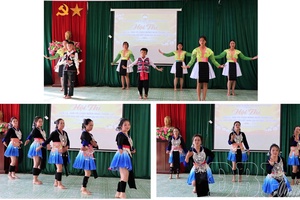
Preparing for a spring tour.

When arriving in the new land, they faced a number of challenges. This is a common fact: Starting from scratch. So do the Sán Chay people!

They began by building homes and clearing fields to cultivate rice. However, their lives was still unstable. They had find wild yams and vegetables in the forest with the hope that their new lives would gradually become more stable.

Mr. Đặng Văn Néng remembered: “At that time, it was not just the difficulties in living facing them. It was also the lack of healthcare service. Because of those struggles and shortages, it was only on special occasions as they invited the shaman for a ritual, each family got to enjoy the taste of chicken.”

After many years of benefiting from the Government’s projects, along with support from various levels and sectors in the province, the Sán Chay community in particular and Huổi Thanh 1 residents in general have learned new farming methods and diversified livelihoods, contributing to improving economic conditions.

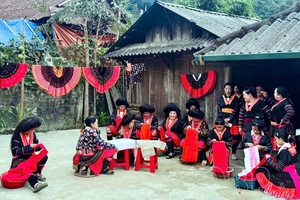
Sán Chay women wear traditional costume to welcome the Lunar New Year.

“In recent years, the lives of the Sán Chay people have changed significantly. Our community has learned to cultivate wet rice, which yields much more than shifting cultivation, so hunger has almost been eradicated. Thanks to the care and support from the Party and State through various practical programs, living standards of local people in the hamlet have improved drastically. Makeshift and downgraded houses have decreased by 80%. In the past, they did not know much about farming techniques, but now they are growing cassava, cinnamon, acacia... Currently, the hamlet has nearly 100 hectares of cassava, supplying raw materials to local factories. Thanks to this, many households now earn from VNĐ 50 to 60 million annually, even VNĐ 70 million from cassava cultivation,” added Mr. Néng.

On the occasion of the 2025 Lunar New Year (Tết) holiday, local people are expected to enjoy a cozy and happy celebration.

Diệp Chi
Comment

You have 500/500 characters left

Please enter 5 or more characters!!!

Recent news

  • 'Preserving beauty of ethnic minority costumes in Na Sang

    Preserving beauty of ethnic minority costumes in Na Sang

    CULTURE - SPORTS -
    ĐBP - Along with their languages and scripts, the traditional costumes of ethnic minority groups reflect customs, traditions and aesthetic values, while preserving knowledge and skills passed down through generations. In Na Sang commune, efforts to maintain embroidery and tailoring traditions, together with classes teaching traditional pattern-making techniques, are helping preserve the cultural identity of local ethnic communities.
  • 'Nà Hỳ restructures crops

    Nà Hỳ restructures crops

    ECONOMY -
    ĐBP - From swiddens cultivating corn, rice, and cassava on steep land, the people of Nà Hỳ commune are gradually shifting to planting coffee, macadamia, and several perennial industrial crops of high economic value.
  • 'Innovating leadership methods, generating growth momentum

    Innovating leadership methods, generating growth momentum

    ECONOMY -
    ĐBP - Executing the 11.02% growth target for 2026, in the closing months of the year, alongside efficiently exploiting resources, Điện Biên province is focusing on innovating leadership, directing, and administrative methods toward clear objectives, specific solutions, distinct responsibilities, and resolute execution.
  • 'Transparent procurement prices, protecting coffee growers

    Transparent procurement prices, protecting coffee growers

    ECONOMY -
    ĐBP - Faced with the reality that fresh coffee procurement involves multiple focal points and prices between trading spots can fluctuate, local administrations have coordinated with enterprises to maintain daily price transparency, helping farmers proactively choose where to sell and curbing price-squeezing.
  • 'Removing barriers, narrowing gender gap

    Removing barriers, narrowing gender gap

    SOCIAL AFFAIRS -
    ĐBP - Through practical approaches, the Women’s Unions at all levels in the province have recently stepped up communication on gender equality, supporting women in developing livelihoods, creating jobs, and enhancing their capacities.
  • 'Sowing seeds of green agriculture

    Sowing seeds of green agriculture

    ECONOMY -
    ĐBP - Possessing a vast agricultural and forestry land fund alongside diverse, distinctive microclimates, Điện Biên holds substantial headroom to develop green agriculture. From expanding Arabica coffee, macadamia, and fruit tree zones to organic, VietGAP, and high-tech application models, a new direction is steadily taking shape: advancing agriculture not merely by scale, but placing sharper emphasis on quality, value, and sustainability.
  • 'Protecting biodiversity “treasure trove”

    Protecting biodiversity “treasure trove”

    ECONOMY -
    ĐBP - In the westernmost region of the Fatherland, the verdant forests of Mường Nhé Nature Reserve stretch across frontier mountain ranges, where a diverse ecosystem converges with thousands of flora and fauna species coexisting. Spanning 46,577.19ha of forest and forestry land, this sanctuary preserves valuable natural habitats. Conserving that space contributes to safeguarding biodiversity while unlocking potentials for scientific research, eco-exploration, and elevating forest ecosystem values.
  • 'Change begins with mindset and methods

    Change begins with mindset and methods

    ECONOMY -
    ĐBP - Departing from the center of Điện Biên Phủ ward, after more than two hours of riding a motorbike along winding roads with hairpin turns, we arrived at Long Dạo village, Si Pa Phìn commune.
  • 'New crops in Thộ Lộ

    New crops in Thộ Lộ

    ECONOMY -
    ĐBP - Located nearly 20km from the commune center, Thộ Lộ village, Búng Lao commune, comprises 37 households, 100% of whom belong to the Hmông ethnic group.
  • 'Protecting legitimate rights and interests of land users

    Protecting legitimate rights and interests of land users

    ECONOMY -
    ĐBP - Land is a crucial material of production, directly linked to the livelihoods, assets, and daily lives of the people. Therefore, effective land management goes beyond merely grasping current status and controlling usage; it must guarantee the legitimate rights and interests of land users.