Preserving traditional craft of Dao ethnic group’s handmade paper

ĐBP - Making handmade paper is a long-standing traditional craft of the Dao ethnic people living in Đề Tâu hamlet, Mường Đun commune (Tủa Chùa district, Điện Biên province). This craft has been passed down through generations, becoming an integral part of the daily lives of Dao women here.

The Dao ethnic group boasts a rich and distinctive culture, reflected through their customs, traditions, language, script, and traditional crafts. Dao villages are often located in remote and isolated areas, separated from other ethnic groups, allowing their cultural and spiritual life to remain largely intact. Among these, traditional crafts hold a significant position, meeting the essential needs of daily life.

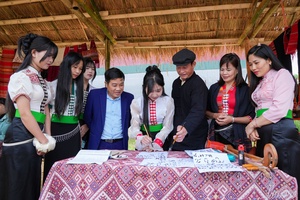
Making handmade paper is a traditional craft of the Dao ethnic people.

Every year, the Dao ethnic people organize numerous rituals and worship ceremonies, requiring a substantial amount of paper. The Dao have their own script (Nôm Dao), and the use of traditional paper for recording genealogy and preserving documents from generation to generation is indispensable.

Paper-making is primarily undertaken by the women, including mothers and grandmothers, of the Dao ethnic group.

In Đề Tâu hamlet, the Dao ethnic group lives in a close-knit community of nearly 30 households, all of whom engage in paper-making. The Dao use paper for daily activities, making the craft of handmade paper a primary occupation for women during the dry season to supplement their income. Notably, paper-making is predominantly carried out by the women, including mothers and grandmothers.

Traditional handmade paper is often thick and durable, favored by the Dao for use in rituals and recording documents.

Chảo Thị Ghến from Đề Tâu hamlet shared: “The paper we make is partly used for family needs, such as during festivals, Tet holidays, or worship ceremonies. The rest is sold at local markets for VND 10,000 per sheet. As a traditional handicraft product, it is highly appreciated by customers, with the main buyers being the Mông ethnic people. At each market day, we can sell hundreds of sheets, providing a good income for the family.”

Raw materials are preliminarily processed, soaked for half a month, and pounded into paper pulp.

The craft of making Dao handmade paper involves numerous meticulous and skillful steps performed by the women. The raw materials used for paper-making are diverse, including young bamboo and tree bark, which are split, stripped, and soaked in lime water or ash water. The soaking process typically lasts half a month; once the materials turn white and soft, they are pounded and ground into paper pulp. After obtaining the pulp, Dao women mix it with water from forest trees in an appropriate ratio to create adhesion, then spread it evenly onto a fabric frame and dry it.

The whiteness, thickness, and overall quality of the paper depend on the raw materials, the maker’s experience, and the skill in evenly spreading the paper mixture onto the fabric frame.

The quality of the finished paper depends on experience and skill.

Tẩn Thị Dao from Đề Tâu hamlet said: “Depending on the number of paper-making frames each family owns, we can produce about 400 to 600 sheets a week. During the sunny months of the dry season, we focus on making paper, both producing and storing it, as handmade paper is very durable and doesn’t spoil even after several years. At each market day, I sell between 30 and 60 sheets, and I sell year-round.”

The craft of paper-making in Đề Tâu hamlet not only generates additional income and supports family economies but is also closely tied to preserving and promoting the traditional culture of the Dao ethnic group in modern life.

Trần Nhâm
Comment

You have 500/500 characters left

Please enter 5 or more characters!!!

Recent news

  • 'Thanh Yên creates consensus to deploy key projects

    Thanh Yên creates consensus to deploy key projects

    SOCIAL AFFAIRS -
    ĐBP - Recently, with the close direction of the Party committee and authorities of Thanh Yên commune, the work of dissemination and mobilizing people to implement projects in the area has been deployed synchronously and effectively. Thanks to that, people have increasingly raised their awareness, agreed with the State’s guidelines, actively coordinated, and contributed importantly to the project implementation process.
  • 'When cultural identity becomes “soul” of homestay model

    When cultural identity becomes “soul” of homestay model

    TRAVEL -
    ĐBP - From Thái stilt houses and Hà Nhì earthen-walled houses to decorative details imbued with the traditional culture of the Hmông people... many homestays in Điện Biên are choosing the path of “telling cultural stories” through accommodation spaces.
  • 'School rises from hardship

    School rises from hardship

    SOCIAL AFFAIRS -
    ĐBP - Despite facing numerous difficulties regarding facilities, teaching equipment, and living conditions for boarding students, in recent years, Chiềng Đông Secondary School, Búng Lao commune, Điện Biên province has been assessed as a unit with many positive changes in teaching and learning.
  • 'Crop restructuring drives sustainable agriculture in Điện Biên

    Crop restructuring drives sustainable agriculture in Điện Biên

    ECONOMY -
    ĐBP - Điện Biên province is restructuring its crop mix, identifying the expansion of coffee, macadamia and fruit trees as the backbone of a green, sustainable agricultural development strategy. This orientation is set out in the provincial Party Executive Committee’s Resolution on restructuring the agricultural sector toward concentrated, green, smart and sustainable commodity production for the 2026-2030 period, with a vision to 2035.
  • 'Expanding market for local agricultural products

    Expanding market for local agricultural products

    ECONOMY -
    ĐBP - In Điện Biên province, in the context of agriculture shifting strongly from the mindset of “producing what we have” to “producing what the market needs,” bringing local agricultural products to become specialties and conquering larger markets is opening up a sustainable direction for farmers.
  • 'Unity dance by Đà River

    Unity dance by Đà River

    CULTURE - SPORTS -
    ĐBP - In the early days of 2026, when the morning mist still lingered on the water surface of the Sơn La Hydropower Reservoir, we were present in Mường Lay ward, Điện Biên province.
  • 'Well preparing for “Compassionate Tết” program

    Well preparing for “Compassionate Tết” program

    SOCIAL AFFAIRS -
    ĐBP - The “Compassionate Tết” program for the 2026 Lunar New Year (Tết) – the Year of the Horse is a humanitarian activity of deep significance, aiming to care for and support poor households and individuals in difficult circumstances in Điện Biên province, helping them have the conditions to enjoy spring and welcome Tết.
  • 'Điện Biên builds concentrated raw material areas

    Điện Biên builds concentrated raw material areas

    ECONOMY -
    ĐBP - In highland communes of Điện Biên province, agricultural production was previously mainly small-scale and fragmented by household. This led to difficulties in scaling up and organizing consumption according to the value chain.
  • 'Bringing digital government closer to people in Điện Biên

    Bringing digital government closer to people in Điện Biên

    SOCIAL AFFAIRS -
    ĐBP - From installing the VNeID app to completing administrative procedures on smartphones, the “Digital literacy for all” movement is steadily bringing digital government closer to the people of Điện Biên. Beyond making public services more accessible, the initiative is playing a key role in accelerating administrative reform and building a modern, efficient grassroots administration.
  • 'How Điện Biên needy people escape poverty

    How Điện Biên needy people escape poverty

    ECONOMY -
    ĐBP - Once poor and near-poor households with difficult lives, thanks to timely access to support programs and projects of the Party, the State, and social organizations along with suitable livelihood models, many families in highland communes have gradually stabilized their lives.
  • 'Accompanying taxpayers

    Accompanying taxpayers

    ECONOMY -
    ĐBP - The transition from flat tax to declaration-based tax starting in 2026 is assessed as a step suitable for modernization, transparency, and integration goals, but business households must adapt to a model completely different from long-standing habits.