



Part 3: From commitments to actions
Party committees and authorities at all levels are shifting decisively from a “management” mindset to a “service” mindset, moving from administrative procedural reforms and resolving obstacles to actively accompanying enterprises during project implementation, fostering a favorable climate to transform investment pledges into tangible undertakings and projects that generate renewed growth momentum.
“Green lane” paving the way for capital inflows
Following the investment promotion conference, the question facing the province is no longer how much capital has been attracted, but what must be done so investment pledges quickly materialize into operating projects that generate goods, employment, and resources for the economy.
.jpg)
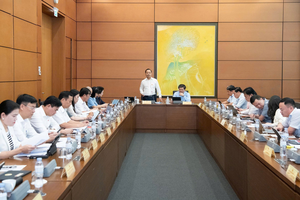
Among the measures immediately deployed by the province was concretizing its commitment to the “green lane” mechanism in processing administrative procedures. The provincial People’s Committee issued a list of 26 provincial administrative procedures and 4 commune-level procedures subject to the “green lane” mechanism, focusing on areas with direct impacts on investment, production, and business operations. Among these, 6 procedures in industry and trade saw processing times cut by up to 70%; 2 procedures in culture, sports, and tourism were reduced by 50%; and 2 procedures in health were shortened by up to 70%. The Department of Finance achieved cuts between 60% and over 82% in handling times across 6 procedures. In agriculture, environment, and land administration alone, 7 procedures were shortened by 43.8% to 72.2%.
According to Nguyễn Tiến Cường, Deputy Chief of the Office of the Điện Biên provincial People’s Committee, the core of the “green lane” mechanism lies in selecting procedures that directly influence investment progress to prioritize processing, while defining distinct accountability across each agency and stage. The objective is that dossiers must be handled immediately as they arrive, eliminating delays, bureaucratic detours, or shifting of responsibility. Shortening timeframes must nevertheless ensure compliance with legal provisions, preserve public transparency, and control procedural processing quality.
This approach reflects how the province concretizes the pledge delivered by provincial Party Secretary Trần Tiến Dũng at the Investment Promotion Conference: effectively leveraging the “green lane” mechanism, cutting administrative processing times, clearing bottlenecks between higher and lower administrative tiers, and resolutely penalizing evasion, shifting of duty, or bureaucratic harassment. Thanks to this initiative, since the beginning of the year, Điện Biên province has granted investment decisions to 23 projects with a total capital of VND 53,000 billion, including 3 foreign direct investment (FDI) projects totaling VND 14,005 billion in registered capital.
.jpg)
Lê Xuân Cảnh, Director of the Department of Agriculture and Environment, stated that Điện Biên is building the most open and favorable mechanism for investors to access and complete project formalities, especially land-related paperwork. Focal projects enjoy the “green lane” mechanism, drastically compressing procedural processing timelines and facilitating swift implementation.
However, the “green lane” represents more than a shortened administrative workflow. Behind these reduced processing times lies a shift in governance philosophy: the administration proactively designs processes to serve development, rather than leaving businesses to navigate intricate regulations on their own.
In the competition for investment, this serves as an essential element shaping local attractiveness. Enterprises seek not merely raw potential, but an environment offering procedural clarity, transparent accountability, a supportive administration, and the capability to rapidly translate investment decisions into operational projects on the ground.
Accompanying investors
While the “green lane” serves as the institutional solution to systemic bottlenecks, grassroots Party committees and local administrations are stepping directly into action, coordinating proactively with investors to resolve emergent hurdles and keep projects progressing on schedule.
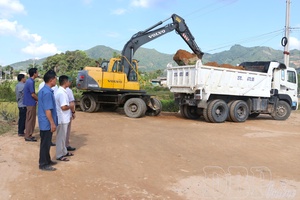
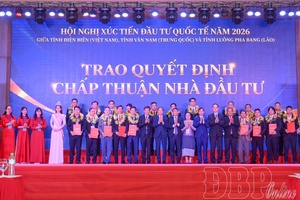
At the Investment Promotion Conference, the provincial People’s Committee awarded the investor approval decision to Vinenergo Energy Joint Stock Company under Vingroup to implement the Điện Biên 1 Solar Power Plant project, featuring a capacity of 300MW and total investment exceeding VND 5,371 billion. Covering a site of approximately 509ha across Điện Biên Phủ ward and Mường Ảng, Pu Nhi, Na Son, Mường Lạn, and Xa Dung communes, the provincial Party Committee and provincial People’s Committee immediately directed departments, sectors, and localities to execute site clearance swiftly to facilitate rapid project deployment. By the end of August 26, local authorities, in coordination with the investor, completed payouts to 505 households across 417ha, reaching 90% of the project’s total land area.
.png)
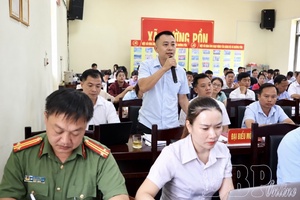
Na Son commune encompasses over 197ha within the clearance boundary, the vast majority of which consists of local farming land. Party committees and local authorities therefore determined that mass mobilization must lead the way. The commune People’s Committee established a site clearance support team, assigned distinct duties to each member, and leveraged the influence of village Party cell secretaries, village heads, and prestigious community elders to communicate policies to the public.
Nguyễn Thanh Lâm, Vice Chairman of the People’s Committee of Na Son commune, noted that winning public consensus requires cadres themselves to fully understand guidelines and master policies so they can explain them clearly to the people. The commune focused on patient communication, active listening, dialogue, clarifying individual inquiries, and securing lawful benefits for residents in accordance with state regulations.
Na Lanh village accounts for more than 30ha of farmland belonging to nearly 30 households within the project zone. To establish consensus, the Village Development Board repeatedly visited individual homes to hold discussions and explain investment policies, compensation and support frameworks, and post-clearance livelihood stabilization plans.
Lò Thị Mai, Secretary of the Party Cell of Na Lanh village, shared that cadres explained to villagers that this is a key provincial undertaking which, upon completion, will foster economic growth, raise fiscal revenue, and generate employment opportunities. Once clear on the purpose, residents voiced strong agreement and support, enabling Na Lanh village to conclude site clearance within the project boundary.
.jpg)
Lò Văn Hoàng, a resident of Na Lanh village, recounted that his family handed over 2ha of agricultural land to serve the project. Initial hesitation gave way after cadres provided thorough explanations, helping him realize that the initiative serves local development while safeguarding citizens’ lawful rights, prompting his household to agree to the land handover.
Following the investment promotion conference, Urban Infrastructure Development Joint Stock Company No.6 under the Điện Biên provincial Trading and Construction Corporation surveyed and proposed a social housing project in Yên Trường hamlet, Thanh Yên commune. Spanning roughly 48,850m² with an estimated preliminary investment exceeding VND 301 billion, the project features 280 social housing units, 36 commercial houses, and synchronized technical infrastructure.
To accelerate implementation, the Party committee and administration of Thanh Yên commune adopted an approach of early, grassroots-level companionship. Nguyễn Văn Toản, Secretary of the Party Committee of Thanh Yên commune, stated that the locality applied the “green lane” mechanism, collaborating with the investor from site survey, public communication, and resident mobilization stages through to completing relevant formalities.
Initial reviews identified 24 households in Yên Trường hamlet with production land inside the project perimeter. Nguyễn Văn Lượng, Secretary of the Party Cell of Yên Trường village, noted that the Hamlet Development Board proactively engaged residents to clarify project objectives and value, securing broad household consensus and enthusiasm for early implementation to stimulate local socioeconomic progress.
Provincial departments and sectors have likewise accompanied businesses directly. Bùi Văn Luyện, Director of the Department of Construction, stated that the department coordinated with relevant bodies and the Party committee and government of Thanh Yên commune to resolve emerging issues promptly and support the investor through administrative procedures.
According to schedule, the project commenced in the third quarter of 2026 and is slated for completion and commissioning in March 2027. Bùi Anh Tiến, Director of Urban Infrastructure Development Joint Stock Company No.6, affirmed that resolute, synchronized actions from Party committees, local governments, and provincial departments provided favorable conditions for the enterprise during project investment preparations.
.jpg)
These undertakings illustrate the decisive, coordinated engagement across the political apparatus from the provincial to grassroots levels in fostering a favorable environment for investors. At the provincial level, this means streamlining workflows and clarifying accountability; across departments, it entails seamless coordination in processing dossiers; at the commune level, it is characterized by direct dialogue and public mobilization; and across villages and hamlets, it hinges on the active leadership of Party cells, village heads, and community elders.
The notable progress following the investment promotion conference extends beyond the number of days shaved off procedures or the volume of newly launched projects. Deep down, it reflects an evolution in leadership and governance methodology. Rather than processing work on a fragmented, procedure-by-procedure basis, Party committees and authorities proactively identify bottlenecks capable of impeding capital flows to resolve them in a focused manner.
The governance approach has moved from demanding businesses navigate bureaucratic systems on their own to designing public services around corporate needs, and from general appeals for public consensus to detailed dialogues that explain policies and secure legitimate rights for citizens across every project. This represents the method for translating Party resolutions from written documents into active dossiers, field dialogues, and concrete local decisions.
A resolution gains authentic vitality only when expressed through shortened procedures, closer public engagement, accelerated decision-making, and operating physical projects. For Điện Biên, the path from clearing bottlenecks to receiving capital flows establishes a broader mandate: transforming today’s investments into new growth engines while widening development horizons across the province.
Phạm Trung - Tuấn Anh
.jpg)
.jpg)
.jpg)
.jpg)
.jpg)
.jpg)
.jpg)
.jpg)
.jpg)
.jpg)
.jpg)
You have 500/500 characters left
Please enter 5 or more characters!!!