



Part 2: The resolution paves the way for aspirations of rising up
That vision reflects a determination to lift Điện Biên’s agriculture out of fragmented production methods and establish concentrated commodity zones, tying the responsibility of Party committees, local administrations, and principal leaders to green, smart, and sustainable development targets.
Opening a new stage of development
Originating with coffee in the Ẳng Nưa Youth Settlement Village and the first macadamia grove in Pha Làng village, the accomplishments achieved by pioneering households confirmed the adaptability and economic efficiency of these two crops on Điện Biên soil. This also provided the practical basis for Điện Biên province to issue Resolution No.09-NQ/TU on July 29, 2021, to progressively expand production zones, foster linkages, and create additional livelihoods for the people. After five years of implementing the resolution, the province’s total macadamia acreage increased from 265ha to over 12,360ha, roughly a 46-fold jump, while coffee expanded from 3,220ha to over 8,140ha, increasing approximately 2.5 times. The development perimeter broadened from traditional cultivation pockets to localities with favorable conditions, initially establishing concentrated production zones and coffee-macadamia intercropping models.
Frequently conducting field inspections in coffee and macadamia growing areas, Lê Xuân Cảnh, Director of the Department of Agriculture and Environment of Điện Biên, observed that many low-efficiency farming plots were proactively converted by local people to coffee and macadamia. The intercropping model initially demonstrated distinct advantages, as macadamia provides shade and retains moisture, while coffee yields early harvests to generate supplemental income while waiting for macadamia trees to bear fruit. However, cultivation areas in many localities remain scattered; seed stock and farming techniques lack uniformity; and infrastructure for irrigation, in-field transport, preliminary processing, and preservation remains inadequate. Linkages among farmers, cooperatives, and enterprises are not yet close; most products are sold raw with low added value, leaving the risk of bumper harvests bringing price drops ever present.
Lê Xuân Cảnh, Director of the Department of Agriculture and Environment, affirmed that raising the value and efficiency of agricultural production requires Điện Biên to shift from acreage expansion to industrial commodity development, linking raw material zones with processing and consumer markets. Planning must align with local conditions, while elevating the role of enterprises, cooperatives, and citizens in organizing production, managing quality, and building brand recognition..jpg)
Building upon the review of Resolution No.09 and concretizing agricultural development orientations set out in the Resolution of the 15th Provincial Party Congress, on December 31, 2025, the Executive Board of the provincial Party Committee issued Resolution No.11-NQ/TU on restructuring the agricultural sector toward concentrated, green, smart, and sustainable commodity production for the 2026 - 2030 period, with orientations toward 2035. Resolution No.11 establishes the target of developing approximately 70,000ha of concentrated commodity production zones by 2030. This encompasses 40,000ha of macadamia, over 20,000ha of coffee, 3,000ha of fruit trees including pineapples and passion fruit, and 6,500ha of vegetables. Điện Biên aims to become the province with the largest macadamia area nationwide and the second-largest Arabica coffee cultivation acreage in the country.
Alongside defining acreage metrics, Resolution No.11-NQ/TU details the spatial development of crops across 45 communes and wards with the clear recommendation that expanding crop areas must rely on specific advantages and local conditions, avoiding trend-chasing. Commune-level authorities are directly charged with organizing rollout, bearing responsibility for reviewing land banks, mobilizing citizen participation, and connecting participating stakeholders, with implementation results tied directly to the performance evaluation of Party committees, local governments, and principal leaders.
Under the new development approach, Điện Biên defines enterprises, cooperatives, and farmers as the primary actors, with the State playing an enabling, guiding, and supporting role. Partnerships among stakeholders must be concretized through designated raw material zones, unified technical procedures, procurement contracts, and clear risk- and benefit-sharing mechanisms. This stands as a prerequisite to overcome self-directed farming, broken linkages, and reliance on private middlemen.
Throughout the entire production cycle, science, technology, and digital transformation are treated as critical pillars, beginning with the construction of cultivation zone databases, digital mapping, electronic farming diaries, product traceability, and quality transparency. Technical advances in seed varieties, water-efficient irrigation, crop care, harvesting, and preservation are anticipated to heighten yields, lower input costs, and enhance climate change adaptation.
Assigning clear targets and concrete responsibilities
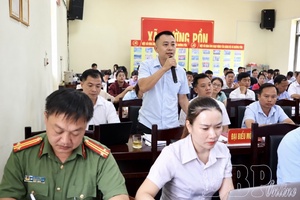
Rolling out Resolution 11, the Kép Ly Village Party Cell in Chiềng Sinh commune regularly organized thematic meetings on implementing the resolution, extending attendance to the public to communicate targets and execution methods. The Party branch committee assigned specific Party members to oversee household clusters, requiring each member to follow and assist seven to eight families throughout the process. Thanks to this, tree planting and maintenance were monitored closely, where a well-performing household served as a visual demonstration for neighboring families to observe, learn from, and follow.
Lường Văn Mười, Secretary of the Kép Ly Village Party Cell, stated that Kép Ly village comprises 344 households with 1,543 residents, yet agricultural land remains scarce because most land is zoned for forestry. To select crops that generate long-term value, the Party cell organized multiple expanded meetings inviting families to learn about Resolution 11, after which residents discussed and selected suitable varieties. With consensus between citizens and Party members, Kép Ly village completed planting 1.7ha of coffee and macadamia in 2026, raising the total area of these two crops across the entire village to 7.1ha.
Lường Văn Mười added that throughout execution, the Party cell assigned specific Party members, including Lường Văn Cơi, Quàng Văn Chinh, and Cà Văn Thoan, to supervise individual household clusters, with each monitoring seven to eight neighboring homes to provide direct, hands-on guidance.
In Mường Mùn commune, target assignment under Resolution 11 was concretized into precise acreage, specific areas, clear timelines, and designated personnel in charge. Trần Khắc Tuấn, Secretary of the Mường Mùn Commune Party Committee, shared that in executing Resolution 11, the Commune Party Committee directed the establishment of working taskforces to survey all inefficient upland fields, subsequently notifying villagers of every zoned plot designated for crop conversion.
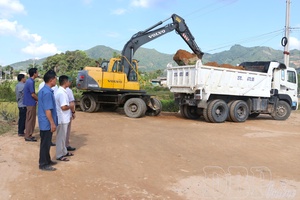
During peak seasonal periods, cadres and Party members traveled directly to the fields to inspect soil preparation, planting holes, and seedlings, guiding farmers on planting, basal fertilization, and routine care. Bottlenecks regarding land, seed stock, farming techniques, or cropping calendars were recorded and resolved right at the grassroots. Responsibility was thus extended from initial land demarcation and registration until crops took root, developed, and formed stable production zones.
Through this method, in 2026 Mường Mùn completed new planting across 1,142ha of coffee, nearly tripling the provincial target, while macadamia planting exceeded 400ha, substantially surpassing the quota assigned by the province.
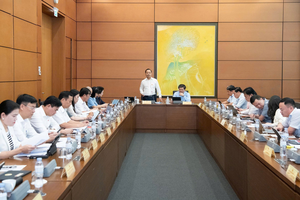
Practical experiences in Chiềng Sinh and Mường Mùn demonstrate that translating a major policy into reality requires more than general instructions. Targets must be quantified, areas must have dedicated supervisors, and execution processes must be tracked to completion. This reflects how the provincial Party Committee structured tasks and metrics across sectors and levels when formulating and promulgating Resolution No.11-NQ/TU on key crop zone development. The province assigned minimum key crop growth targets to each commune and ward, while establishing Steering Committees for Agricultural Restructuring at both provincial and commune tiers. Provincial Party Committee members were assigned to supervise specific communes, while members of commune Party Standing Committees directly oversaw designated villages and hamlets. Implementation outcomes remain tied to assessing the performance of cadres, particularly heads of administrative and Party units, throughout the rollout of the resolution.
Song Phương
.jpg)
.jpg)
.jpg)
.jpg)
.jpg)
.jpg)
.jpg)
.jpg)
.jpg)
.jpg)
You have 500/500 characters left
Please enter 5 or more characters!!!