



Aiming to expand development across 45 communes and wards, Resolution No.11-NQ/TU dated December 31, 2025 of the 15th Điện Biên Executive Board of the provincial Party Committee opens up a new production space, linking the expansion of raw material zones with technological application, value chain connectivity, deep processing, and branding for products derived from these key crops. This represents a transition from fragmented, small-scale farming to a green, smart, sustainable commodity agricultural economy, carrying the farmers’ aspiration for prosperity and Điện Biên’s determination to rise in the new development phase.
Part 1: The journey from poverty reduction crops to key crops
Nearly three decades ago, coffee trees were planted on difficult land at the foot of Tằng Quái Pass by pioneering young households. More than 20 years later, macadamia continued to take root on the hillsides of Tuần Giáo at the foot of Pha Đin Pass. Overcoming numerous seasons of natural disasters, price drops, and initial skepticism, two crops that once carried hopes of escaping poverty have gradually affirmed their suitability to natural conditions, expanding livelihoods for residents and becoming key crops in Điện Biên’s commodity agricultural development strategy.
Sowing green at the foot of the pass
Amidst lush green coffee plantations at the foot of Tằng Quái Pass, the Ẳng Nưa Youth Settlement Village, now part of Mường Ảng commune, has taken on a new look. Well-built houses stand side by side next to fruit-laden coffee groves, while the lives of local residents have become increasingly stable. Few could imagine that nearly three decades ago, this place was an arid land welcoming young HHmông ethnic families who arrived to establish their livelihoods with meager belongings and an ardent desire to escape poverty.
Walking slowly between rows of coffee trees that have been attached to his family for nearly 30 years, Lầu Chồng Lử in Na Luông village, Mường Ảng commune gently lifts each branch, observing the clusters of ripening fruit. At the age of 60, he knows by heart every season of blooming and fruiting, recognizing even the slightest changes in the garden after every spell of rain and sunshine. To him, coffee is not merely a crop that generates income. Each tree trunk also preserves memories of leaving his native village, overcoming hunger and poverty, and building a village on new land.
.jpg)
In April 1998, Lầu Chồng Lử together with 12 families from Hua Sa A and Hua Sa B villages in the former Tỏa Tình commune of Tuần Giáo district arrived in Ẳng Nưa under the youth pioneering resettlement program implemented by the Lai Châu provincial Youth Union, now the Điện Biên provincial Youth Union. Nearly 60 people left their homeland carrying labor tools and modest food provisions with the aspiration of finding a settled home.
With the support of the provincial Youth Union and local residents, the families built houses together and cleared land for agriculture. The first 26ha of coffee were planted with the expectation of creating long-term livelihoods. Accustomed to slash-and-burn farming, households had to relearn everything from digging holes and planting saplings to tending trees and channeling irrigation water. Yet three years later, just as the groves turned verdant, a severe frost spell caused dozens of hectares of coffee to wither yellow, leaving many trees bare. Confronted by poverty and natural disaster, 7 out of the 12 families returned to their native home.
Undeterred, Lầu Chồng Lử alongside several other households, including Lầu Vả Mua, Mùa A Tòng, and Lầu A Lếnh, remained steadfast in holding onto the land. They mounded soil around each trunk, searched for irrigation water sources, and persevered in rehabilitating the coffee orchards. Their hard work was rewarded when, in 2004, the coffee slopes ripened red simultaneously. The first harvest brought both a bumper crop and favorable prices, compensating for six grueling years and opening a path out of poverty for the families who stayed.
From the initial 26ha, residents gradually expanded the coffee area into neighboring localities. Villagers from Tỏa Tình and Pú Nhung came to learn cultivation methods and ask for seedlings, while several families that had once abandoned the village also returned to establish livelihoods.
Through years of close attachment to the people, coffee has proven its adaptability to local climatic and soil conditions, transforming from a livelihood crop contributing to poverty alleviation into the key crop of Mường Ảng commune. Currently, the whole commune maintains nearly 1,700ha of coffee, with an average fresh fruit output reaching approximately 16,500 tons per year; in 2025 alone, parchment coffee output reached 3,300 tons.
From the first coffee trees planted out of an aspiration to escape poverty, after nearly three decades, Mường Ảng has formed a concentrated commodity production zone. That journey demonstrates that for a new crop to take root in a challenging land, it requires the perseverance of the people, the partnership of Party committees and authorities, and time to affirm efficiency. The lesson from the coffee slopes at the foot of Tằng Quái Pass continues to be written on the hillsides beneath Pha Đin Pass, as residents in Tuần Giáo boldly introduced macadamia trees, opening up a fresh livelihood direction.
Paving way for macadamia to take root
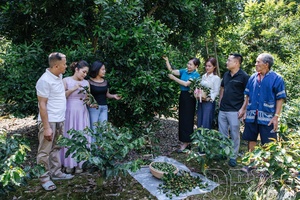
Unlike the farmers in Ẳng Nưa Youth Settlement Village when adopting a new crop, Là Văn Chanh, an ethnic Thái man in Pha Làng village, Tuần Giáo commune, proactively sought out macadamia seedlings to plant after many years of cultivating all kinds of crops without escaping poverty.
Recalling the early days of planting, Là Văn Chanh still remembers that in April 2013, when macadamia was an unfamiliar name to most residents in Tuần Giáo in particular and Điện Biên in general, he painstakingly sought to purchase 200 seedlings because he heard people say this crop is robust, easy to tend, possesses high economic value, and yields harvests across many years, whereas in reality he had never once seen how the tree grew. Consequently, when bringing 200 macadamia trees home to plant, Là Văn Chanh faced skepticism from many neighbors who believed this was an alien plant that would struggle to take root and produce economic returns. Paying no heed, he meticulously dug holes, applied basal fertilizer, planted the seedlings, and mounded the roots strictly according to the nursery’s instructions. Less than a week later, the trees he planted began putting forth young leaves, moving him to tears of joy.
After two to three years of cultivation, macadamia began flowering and yielding its first fruit, while Là Văn Chanh still had no knowledge of post-harvest care or the consumer market for this fruit. Looking up phone numbers to call the seedling vendor, only then did he learn that macadamia encompasses many different varieties, and the trees he had purchased belonged to the 788 variety. From that point on, Là Văn Chanh continued spending time researching and adding varieties such as A38, 849, 816, and 246 to progressively replace them with more efficient cultivars.
Reflecting on past macadamia harvest periods, Là Văn Chanh thoughtfully recounted that by the seventh and eighth years, the orchard began producing relatively stable yields. But at that exact time, macadamia prices fluctuated sharply. From VND 100 thousand per kg of fresh fruit, the price plummeted to VND 70 thousand, VND 50 thousand, and at times dropped to just VND 30 thousand per kg. The sharp decline in fresh macadamia prices left him feeling disoriented, recalling moments when he took a knife intending to chop down the orchard himself. Yet after many restless nights, he found the answer. Because macadamia is a multi-year harvest crop whose fruit prices depend on world market trends, years of high and low prices are a common reality, so one should not chop down trees merely because of low prices.
Understanding the true value of the macadamia tree enabled Là Văn Chanh to remain steadfast in preserving his orchard over the past decade. Currently, his family owns 1ha of macadamia with about 280 trees, yielding an annual income of more than VND 150 million.
Recognizing the efficiency of Là Văn Chanh’s macadamia orchard, many households in Pha Làng village purchased seedlings to plant. To date, Pha Làng village alone has 70 families cultivating dozens of hectares, while Tuần Giáo commune counts thousands of households growing nearly a thousand hectares of this billion-dollar crop.
Much like the journey of coffee at the foot of Tằng Quái Pass, macadamia in Tuần Giáo traversed years of trial, skepticism, and market volatility to prove its adaptability on Điện Biên soil. Nevertheless, reality also presents new challenges. While cultivation area has grown rapidly, production remains fragmented; seedling quality and farming techniques are uneven; and linkages among farmers, cooperatives, and enterprises are not yet close-knit. Raw material zones in certain places are not linked with processing facilities, while most produce is sold in raw form, resulting in limited revenue value. From coffee trees preserved after the killing frost to macadamia orchards persevering through price downturns, the journey of local residents has proven the potential of both crops on Điện Biên soil. Yet for that potential to become a lasting development driver, a decisive policy is needed to clear the path for the aspiration to surge ahead.
Song Phương
.jpg)
.jpg)
.jpg)

.jpg)


.jpg)
.jpg)
.jpg)
.jpg)
.jpg)
You have 500/500 characters left
Please enter 5 or more characters!!!