



Part 3: Pathfinders
As the two-tier local governance model comes into operation, those connecting vessels become even more crucial. For a guideline or plan to take root in life, it requires individuals who possess deep understanding and “pave the way” through their close, relatable voices to the people.
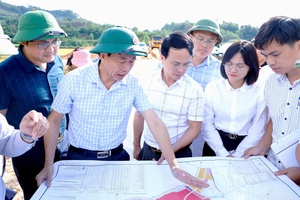
During the initial days when information regarding the social housing project in Yên Trường village, Thanh Yên commune first emerged, residents of both Thanh Yên and Thanh Trường villages could not conceal their concerns and reflections. According to notices from the commune People’s Committee, the locality had planned two industrial clusters with a total area of 78ha, a commercial market zone of 4.8ha, a stationary parking area of 1.2ha, and two social housing projects spanning roughly 6ha in total. These projects directly affected the land area of dozens of households across the two villages.
The locations selected by the commune for planning all offer transportation advantages, adjoining National Highway 12, connecting economic zones, National Highway 279, and Điện Biên Phủ ward. Once deployed, the projects will create vital momentum for Thanh Yên to develop, maintain growth momentum, generate employment opportunities for ethnic children in the locality, and establish a new appearance with synchronous, well-built infrastructure for the border commune in the Mường Thanh basin.
Nguyễn Văn Lượng, Secretary of the Party Cell of Thanh Trường village, shared that hearing information about a project opening up numerous development opportunities for the locality made residents joyful. However, immediately afterward, cadres received a multitude of concerns. If the project were not implemented properly, numerous issues would arise, posing direct difficulties to people’s living conditions. In his role as Party cell secretary, Nguyễn Văn Lượng discussed matters with the village leadership, while directly acquiring and exploring details about the project and construction contractor to disseminate and disseminate information, helping residents clearly grasp contents directly related to their rights and interests.
.jpg)
According to Đoàn Thanh Hải, Head of Thanh Trường village, following the consensus-building dialogue with the commune administration, grassroots cadres like him were regularly present at households to continue implementing related tasks. Because the entire planned land area comprises agricultural production land, residents hoped that when land was recovered, consideration would be given to partially supporting labor spent improving food crops on the land. In the nearly two months since the dialogue, cadres accompanied households, capturing their thoughts, conveying two-way information from the people to the commune and vice versa, and conducting outreach to help families feel assured and maintain trust in the government, enabling the project to accelerate progress swiftly.
While not situated in a site clearance hotspot, the bridge-building role of the village leadership team in Hua Rốm, Nà Tấu commune was brought into play distinctly. In particular, Village Head Vàng A Săng has become an outstanding model of prestige and creative mass mobilization. Hua Rốm village currently has 142 households with 739 residents, 100% of whom belong to the HHmông ethnic group. Clearly recognizing the renewal requirements in the new era, Vàng A Săng mobilized villagers to voluntarily contribute more than VND 20 million from forest environmental service payment funds to purchase a laptop and printer to serve communal tasks.
Vàng A Săng confided that tasks and duties related to administration and procedures in the current context require machinery and equipment. Rather than waiting for State allocations, the village had to be proactive. However, this was a very large amount of money for local people, making consensus difficult to establish. Therefore, cadres had to guarantee publicity, transparency, and democracy. The equipment is placed at the village Cultural House solely to serve public duties and assist villagers in administrative paperwork, particularly on public service software systems. After a period of use, witnessing the practical benefits, 100% of residents supported the decision.
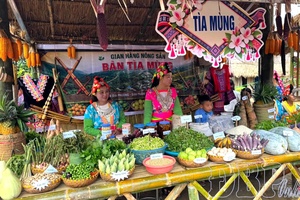
Continuing to promote his role in the locality, upon grasping the commune’s guideline to step up tourism development, Vàng A Săng actively mobilized households to restore and preserve traditional cultural values, particularly in experiential activities, community connections, festivals, and Tết holidays. Notably, when deploying the peach blossom road from National Highway 279 into the village center, Vàng A Săng came up with an initiative: each peach blossom tree has a name tag attached identifying the specific household assigned to manage it.
This method assigns distinct accountability to each family in tending and protecting the trees, ensuring a high survival rate. The village regulation clearly states that any household failing in its responsibility and allowing a tree to die must pay for replacement saplings out of pocket. The peach blossom road promises to create a scenic highlight, beautifying the communal living space and serving tourism development. Through a concrete practice, the responsibility of each household is placed into public affairs, naturally evoking community consciousness.
Điện Biên province has established a widespread network of forces carrying out communication work. The province counts 5 central-level reporters, 50 provincial-level reporters, 315 commune-level reporters, 20 reporters under party committees directly attached to the province, and over 1,200 grassroots communicators. This constitutes the core force staying close to the grassroots and the people, bringing guidelines of the Party, and policies and laws of the State into daily life.
Implementing the policy of streamlining the apparatus and enhancing governance efficiency, Điện Biên completed a large-scale reorganization and merger of residential quarters and villages, creating more streamlined and leaner grassroots focal points. However, as administrative areas are restructured, the mass mobilization network also faces the requirement of being rearranged to keep pace with the new governance space. In the coming time, the province will review, balance, and reassign the contingent of grassroots reporters and communicators to avoid overlap while ensuring remote areas are not overlooked.
Streamlining administrative units does not mean narrowing the presence of mass mobilization. A broader territory, more dispersed population, and diverse socioeconomic conditions and community characteristics underscore that there cannot be a single approach for all locations. What is essential are models flexible enough to adapt to each locality, each population group, and each specific issue, ensuring that across near or distant villages, the voice of the government reaches the people and the thoughts of the people are heard and understood by the administration.
Hà Linh

.jpg)
.jpg)
.jpg)
.jpg)
.jpg)
.jpg)
.jpg)
.jpg)
.jpg)
.jpg)
You have 500/500 characters left
Please enter 5 or more characters!!!