



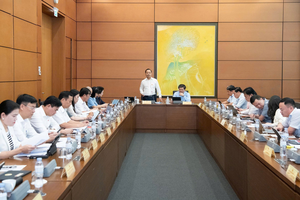
Attending the meeting at the Điện Biên province’s bridge point were comrades: Mùa A Sơn, Permanent Deputy Secretary of the provincial Party Committee; Lê Thành Đô, Deputy Secretary of the provincial Party Committee and Chairman of the provincial People’s Committee; Lò Văn Phương, Member of the provincial Party Standing Committee and Chairman of the provincial People’s Council.
.jpg)
During the meeting, the Government Office announced the Decision to establish the Steering Committee. The Ministry of Science and Technology presented a report on the implementation of tasks related to science, technology, innovation, and national digital transformation as outlined in Resolution No. 57/NQ-TW of the Politburo and Resolution No. 03/NQ-CP of the Government. The ministry also proposed key tasks for immediate action, including establishing a paperless government, as well as enabling digital signing and transactions.
The Ministry of Public Security reported on the progress of tasks assigned under Project 06, including updates on the deployment of the National Data Center and plans to integrate data from national and specialized databases into the National Data Center. The Ministry of Home Affairs shared its progress on assigned tasks related to administrative reform.
The meeting discussed several key issues, including: Digitizing the operation of the land database; building a paperless government, along with digital signing and transactions; enhancing the quality of administrative procedure processing in the electronic environment; planning nationwide 5G network coverage; and maintaining and developing the National Data Center.
Several opinions and recommendations were raised, such as: Focusing on developing a unified, interconnected land management software system nationwide; improving mechanisms, policies, and infrastructure related to land management; minimizing the storage of paper documents; ensuring a safe and secure cybersecurity environment; accelerating the deployment of AI applications across all levels of government; expediting the completion of legal frameworks related to databases; and creating conditions and policies to support small and medium-sized technology enterprises and companies.
.jpg)
In his concluding remarks, Prime Minister Phạm Minh Chính instructed that immediately following the meeting, ministries, sectors, and localities must promptly consolidate their respective Steering Committees and focus on resolving institutional bottlenecks related to science and technology. He called for a review of laws concerning digital transformation, science, and technology, clearly identifying difficulties and obstacles that need to be addressed.
Regarding infrastructure for science, technology, innovation, digital transformation, Project 06, and administrative reform, he posed the question: What physical facilities still need to be developed? He emphasized the need to build a robust workforce capable of meeting current demands for scientific and technological innovation and creativity. Additionally, he urged efforts to tackle bottlenecks in administrative reform and reduce administrative procedures. He stressed that law amendments should focus on six key points: What to remove and why, what to retain, what to supplement and why, ensuring clear decentralization and delegation of authority, and offering specific proposals and recommendations.
Anh Nguyen

.jpg)
.jpg)
.jpg)
.jpg)
.jpg)
.jpg)
.jpg)


.jpg)
.jpg)
.jpg)
You have 500/500 characters left
Please enter 5 or more characters!!!