A leap forward in education and training

ĐBP - Despite challenges in human and financial resources, the education and training sector of Điện Biên Province made significant strides in the 2023-2024 academic year, achieving notable successes across various fields. These accomplishments have positioned education as a highlight in the province’s socio-economic development.

At the beginning of 2025, amidst a busy schedule, Mr. Nguyễn Văn Đoạt, Director of the provincial Department of Education and Training (DoET), took time to share with reporters the remarkable achievements of the sector over the past school year.

Deputy Chairman of the provincial People’s Committee Lò Văn Tiến hands over certificates of merit from the Ministry of Education and Training to individuals in Điện Biên’s education and training sector (2024).

According to him, while Điện Biên still faces certain difficulties as a mountainous region, it also enjoys numerous advantages for educational development. Chief among these is the support from the Central and provincial authorities, organizations, individuals, and benefactors. As a result, the province’s school infrastructure has become increasingly modern and comprehensive, with an extensive network of schools covering even the most remote villages.

Currently, 486 educational institutions operate across all levels in the province, with 78.1% of schools meeting national standards and 76.3% passing education quality accreditation. Apart from resources, the province’s resilient spirit has been a fundamental factor in maintaining its high educational quality compared to other midland and northern mountainous provinces.

Deputy Chairman of the provincial People’s Committee Lò Văn Tiến and DoET Director Nguyễn Văn Đoạt congratulate students who won prizes in the 2023-2024 National Excellent Student Competition.

In the 2023-2024 academic year, Điện Biên recorded its highest high school graduation rate in a decade with 99.51%, up 0.27% from the previous academic year. Of the 36 schools with registered candidates for the national high school exam, 21 achieved a 100% graduation rate, including Lê Quý Đôn Gifted High School, the provincial Ethnic Boarding High School, Mường Lay Town High School, Điện Biên District High School, Mùn Chung High School, and Tả Sìn Thàng Secondary & High School. The remaining schools also recorded graduation rates above 90%.

Although Điện Biên District High School is not one of the province’s major educational institutions, it has consistently improved comprehensive education quality, maintaining its national standard status and earning the trust of both the DoET and the community. In 2023-2024 period, the school exceeded most of its set targets, with over 92.25% of students achieving good or excellent conduct ratings and 63.38% attaining high academic performance. Its high school graduation rate was nearly 100%, surpassing the provincial average by 0.76%.
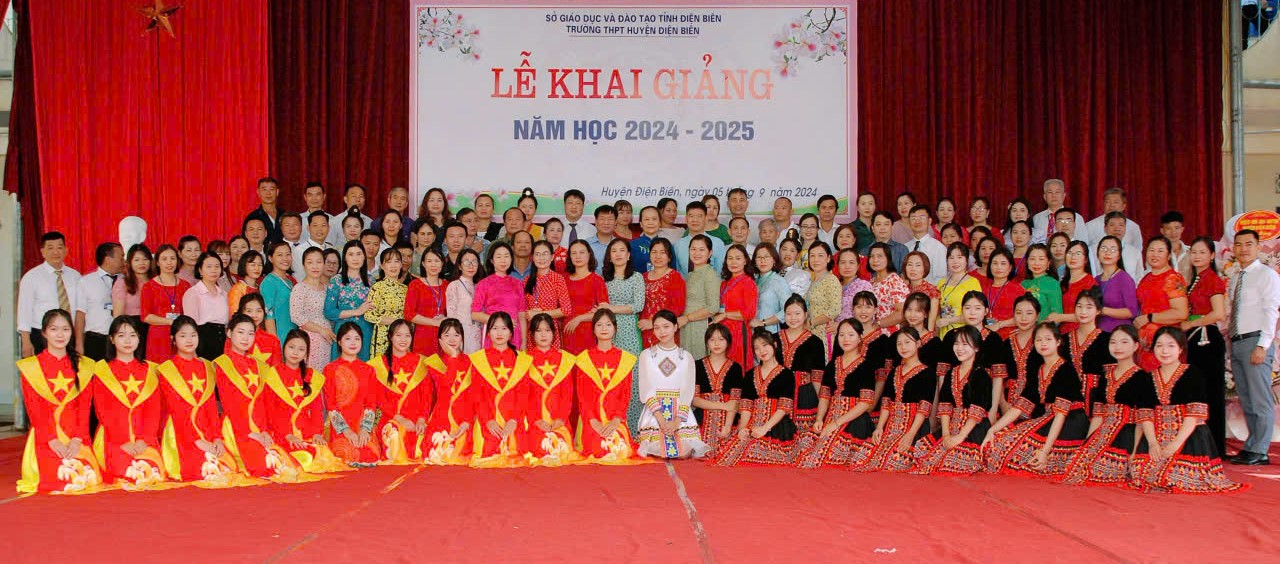
Teachers and students of Điện Biên District High School pose for a commemorative photo at the opening ceremony of the new academic year.

According to Mr. Đào Xuân Mạnh, Vice Principal of Điện Biên District High School, the school places particular emphasis on the quality of teaching. “The achievements of the past academic year reflected the relentless efforts of both teachers and students. With nearly 40 years of development, our school will continue to strive for even greater achievements in the 2024-2025 academic year,” he emphasized.

Despite facing difficulties, the DoET of Điện Biên Province has recorded outstanding results. Notably, the number of students participating in the National Excellent Student Competition reached its highest level, with 26 awards, including three second prizes. For the first time, a student from Điện Biên won second place in Mathematics, and for the third consecutive year, students achieved awards in English. Additionally, Điện Biên led the Northern Border Mountainous Region in school enrollment rates and was recognized by the Ministry of Education and Training as one of the top provinces in implementing the 2018 General Education Curriculum.

Students of Him Lam Primary School (Điện Biên Phủ City) participate in a reading festive day.

2025 marks the final year of the provincial Party Congress for the 2020-2025 term, and till date, most educational targets have been met or exceeded. According to DoET Director Nguyễn Văn Đoạt, as of the 2024-2025 academic year, Điện Biên Province has 482 schools (168 kindergartens, 296 general education schools, 17 training centers, and 1 college), along with 795 kindergarten branches and 360 primary school branches. They house 7,333 classes with 208,046 students and trainees. Compared to the beginning of the term, the province has reduced 5 schools, achieving 101.05% of the set target.

In addition, the kindergarten enrollment rate for children aged 3-5 reached 99.89%, exceeding the target by 0.1%. Other key indicators, such as the enrollment rate for first graders, primary school students aged 6-10, sixth graders, and students attending secondary and high schools, have also surpassed planned goals.

A computer lab donated by the Youth Advisory Board under the Ministry of Public Security to Na Sang Ethnic Boarding Secondary School (Mường Chà District).

With the aim of exceeding the targets set by the provincial Party Congress and the annual plans of the provincial People's Committee, the DoET is committed to implementing comprehensive and systematic reforms in education and training. The primary focus will be on restructuring and streamlining public educational institutions to enhance efficiency and effectiveness.

Key measures include: Developing policies to attract teachers, particularly for remote areas, and improving working and living conditions to ensure long-term commitment; engaging in direct dialogue with educators, administrators, and staff to address concerns and find solutions to pressing issues; proactively advising on the establishment of Điện Biên Phủ University and reorganizing the provincial vocational college to align with the new university structure; and coordinating the establishment of a branch of Thái Nguyên University and an education complex under FPT Corporation in Điện Biên.

Students of Ẳng Cang Secondary School (Mường Ảng District) read books in the library.

Despite numerous challenges, the strong commitment from provincial leaders, education and training sector, and local community has propelled Điện Biên’s education and training sector forward. Looking ahead to 2025 and beyond, the province will continue to prioritize investment in human resources, infrastructure, and modern education models to enhance quality and accessibility.

With determination, innovation, and collaboration, Điện Biên is well on its way to becoming a leading province in educational development in the Northern mountainous region of Việt Nam.

Quang Long
Comment

You have 500/500 characters left

Please enter 5 or more characters!!!

Recent news

  • 'Bringing digital transformation closer to citizens through VNeID

    Bringing digital transformation closer to citizens through VNeID

    SOCIAL AFFAIRS -
    ĐBP - Digital transformation can only achieve its full potential when citizens are able to use and benefit from digital platforms in their daily lives. In Điện Biên province, efforts to bring the VNeID application to local residents, particularly those living in mountainous and border areas, are being actively implemented. From guiding citizens through installation and account activation to integrating digital documents and using online public services, many residents have proactively embraced digital utilities, contributing to the effective implementation of Project 06.
  • 'Điện Biên seizes breakthrough opportunities from digital transformation

    Điện Biên seizes breakthrough opportunities from digital transformation

    ECONOMY -
    ĐBP - Digital transformation was once perceived solely as a matter of technological infrastructure, software, and online public services. However, since the Politburo issued Resolution No.57-NQ/TW, which identifies science, technology, innovation, and digital transformation as the driving forces for national development, that perspective has shifted. For Điện Biên, this is considered a favorable time to leverage new mechanisms, fresh resources, and technological achievements to create breakthroughs in development.
  • 'Building a safer summer for teenagers

    Building a safer summer for teenagers

    SOCIAL AFFAIRS -
    ĐBP - The summer holiday gives teenagers more time away from school, but it is also a period when juvenile law violations tend to increase. From underage driving to acts that threaten public order and safety, such incidents highlight the urgent need for early preventive measures through close coordination among families, schools, and law enforcement agencies.
  • 'Unlocking development resources

    Unlocking development resources

    ECONOMY -
    Faced with this reality, Điện Biên province is focusing on reviewing and untying backlogged projects and handling long-standing “bottlenecks” to unlock resources, creating new momentum for growth during the 2026–2030 period.
  • 'A command from the heart

    A command from the heart

    NEWS - POLITICS -
    ĐBP - In July, amid the blistering heat followed by sudden downpours, there are still people performing a special task at the Tông Khao Martyrs’ Cemetery. Every movement to exhume the graves of martyrs is executed slowly and cautiously, standing as a tribute to those who have rested here for more than seven decades.
  • 'Combating African swine fever for sustainable livestock development

    Combating African swine fever for sustainable livestock development

    ECONOMY -
    ĐBP - Pig farming remains one of the most important sectors of agriculture in Điện Biên province. With a total pig population of nearly 312,000, pigs are not only an essential source of food but also a valuable asset and form of savings for many households. However, the outbreak of African swine fever (ASF) since the beginning of 2026 has posed a major challenge to the province’s goal of developing a safe and sustainable livestock industry.
  • 'Increasing benefits, reducing burdens for people

    Increasing benefits, reducing burdens for people

    SOCIAL AFFAIRS -
    ĐBP - Starting from July 1, 2026, multiple new regulations of the Law on Health Insurance officially take effect, expanding benefits for participants toward more favorable and flexible medical examination and treatment. These adjustments do not only create conditions for the public to access quality medical services and alleviate the burden of treatment costs but also continue to affirm the role of health insurance as an important pillar in the social security system, heading toward the goal of universal healthcare.
  • 'Xa Dung brings resolution into reality

    Xa Dung brings resolution into reality

    NEWS - POLITICS -
    ĐBP - Returning to Phì Nhừ village, Xa Dung commune today, the green hue of newly planted coffee and macadamia areas in recent years is gradually blanketing the degraded cassava and corn fields. This transformation is the initial result of implementing the commune’s Resolution on agricultural restructuring. Bringing the Party’s Resolution into practice has created consensus among the People and step-by-step shaped a new economic development direction for the locality.
  • 'An anchor from new policy

    An anchor from new policy

    SOCIAL AFFAIRS -
    ĐBP - The Government’s Decree No.192/2026/NĐ-CP, taking effect on July 15, 2026, has introduced multiple special allowance regimes for the healthcare sector, including an increase in on-duty allowances and monthly support for village health workers. The policy is expected to create motivation for the grassroots medical workforce to feel secure in their work, upgrading the quality of public healthcare right from the frontline.
  • 'Key to sustainable agricultural development

    Key to sustainable agricultural development

    ECONOMY -
    ĐBP - Điện Biên is gradually making a significant shift from a production-oriented mindset to an agricultural economic mindset. At the heart of this transformation is the development of linkages among farmers, cooperatives, and enterprises, creating concentrated raw-material zones connected to processing facilities and consumer markets.