Minimizing forest fire risk during swidden farming season

ĐBP - After the 2025 Lunar New Year, ethnic communities in mountainous areas of Điện Biên Province prepare for the new farming season.

The dry weather, combined with swidden fields adjacent to forests, significantly increases the risk of forest fires. Therefore, preventing and controlling forest fires during the swidden burning season is considered a top priority in forest protection efforts.

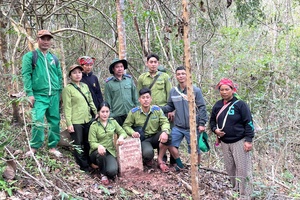
The Forest Protection and Fire Prevention Patrol Team of Residential Quarter 2 in Điện Biên Đông Town, Điện Biên Đông District, currently has eight members. Over the past two months, the team has doubled and even tripled its patrol frequency, a measure that will be maintained until April due to the high fire risk in forests under their management, particularly in areas bordering Keo Lôm Commune.

A forest ranger in Điện Biên District educates locals on fire prevention techniques during swidden burning.

Mr. Cháng A Vàng, Head of Residential Quarter 2 and a member of the patrol team, shared that the team is responsible for managing and protecting over 157 hectares of forest. To prevent fires during the dry season, especially in the swidden burning period, the team’s members take turns patrolling the forest to detect and prevent unsafe clearing and burning of vegetation.

“We have strengthened patrols in areas bordering Keo Lôm Commune, as this is a grazing area where people often burn shrubs to promote grass growth, posing a high risk of fire spreading into the forest,” added Mr. Vàng.

Similarly, in Huổi Lóng Village, Na Sang Commune, Mường Chà District, Village Chief Vừ A Lọi and his forest protection team have been working tirelessly to safeguard the local forests. In addition to intensifying patrols, they are actively educating villagers on fire prevention measures.

Village Chief Vừ A Lọi raises awareness among residents of forest protection regulations.

“The village has nearly 90 households, all of whom have swidden fields. To raise awareness of forest protection, our team is currently spreading information about fire prevention techniques when burning swidden fields. Thanks to effective awareness campaigns, there have been no forest fires caused by swidden burning in our village for over a decade, and our 910 hectares of forest have been well preserved and developed,” he underlined.

Across the province, particularly in mountainous areas, forest protection teams in villages and residential groups have ramped up patrols while also educating local people on safe burning techniques.

Since swidden burning is one of the leading causes of forest fires during this period, villagers are required to inform the village chief before burning. Burning should be avoided during peak heat hours, such as midday or early afternoon, and instead conducted in the late afternoon. Firebreaks at least 4 to 5 meters wide must be created around the edges of the forest, and burning should start from the top of the slope downward. Once about 30% of the area is burned, the fire should be ignited from the bottom up. Crucially, farmers must remain at the site until the fire is completely extinguished.

Residents of Mường Tùng Commune, Mường Chà District clear vegetation in the forested area they are responsible for managing.

According to Mr. Trần Đức Quyền, Deputy Head of the Forest Management, Protection, and Conservation Division under the Điện Biên Provincial Forest Protection Sub-Department, the peak swidden farming season occurs from late February to early April each year. Given the traditional farming practices and production cycles of local people, forest rangers must be on duty 24/7 during the dry season, working closely with commune-level fire prevention and control teams to educate and supervise swidden preparation. These efforts help villagers better understand the importance of forests and the need for fire prevention.

Despite proactive measures emphasizing prevention, challenges remain due to the vast forested areas, rugged terrain, and limited public awareness in some communities. Additionally, unpredictable weather patterns further complicate forest protection during the dry season.

Therefore, alongside efforts by forest rangers and community patrol teams, every villager and forest owner must strictly adhere to forest protection commitments and comply with regulations to reduce the risk of forest fires during the swidden farming season.

Thu Hằng
Comment

You have 500/500 characters left

Please enter 5 or more characters!!!

Recent news

  • 'Digitizing policy credit management

    Digitizing policy credit management

    ECONOMY -
    ĐBP - Faced with the increasingly strong digital transformation situation, the Bank for Social Policies (VBSP) in Mường Chà has deployed many new technology solutions to improve credit management efficiency and facilitate people during the transaction process. One of the important steps is the application of software for interest collection and online policy credit management via smartphones.
  • 'Promptly resolving voter recommendations

    Promptly resolving voter recommendations

    NEWS - POLITICS -
    ĐBP - Resolving voter recommendations is a key task, demonstrating the listening spirit and responsibility of the government towards the people. The Điện Bien provincial People’s Council also strengthens inspection and supervision, ensuring each recommendation is handled with the right authority and on time.
  • 'Điện Biên in cloud hunting season

    Điện Biên in cloud hunting season

    TRAVEL -
    ĐBP - Every late autumn and early winter, when cold winds start to sweep in, it is also the time Điện Biên dons the magical cloak of a sea of clouds - the most beautiful season of the year for nature lovers and explorers.
  • 'Farmers change mindset, enhance production value

    Farmers change mindset, enhance production value

    ECONOMY -
    ĐBP - Using modern machinery and equipment in production processes; transforming crop and livestock structures with high economic value; and changing business methods are practices actively implemented by farmers in Điện Biên province. Thereby showing the change in farmers’ thinking regarding production, economic development, and sustainable poverty reduction.
  • 'Ensuring food safety

    Ensuring food safety

    SOCIAL AFFAIRS -
    ĐBP - The health sector of Điện Biên province currently manages more than 2,100 food production, trading, and catering service establishments. In the context where food of unknown origin remains complex on the market, creating significant challenges for food safety and hygiene assurance.
  • '“Key” to opening digital economy door

    “Key” to opening digital economy door

    ECONOMY -
    ĐBP - The recent Workshop on Trade Promotion, Investment and Promotion of “Make in Vietnam” Digital Technology Products to Promote Digital Economy Development and Digital Transformation in the Northwestern Region was an opportunity for Điện Biên province to connect with technology enterprises.
  • 'Bringing clean water to highland school sites

    Bringing clean water to highland school sites

    SOCIAL AFFAIRS -
    ĐBP - Aiming to help educational facilities in remote and isolated areas ensure stable daily-life water sources, organizations and individuals have joined hands to implement programs of drilling wells, installing storage tanks, and providing water conduction equipment suitable for specific terrain conditions.
  • 'Breaking new ground in building Điện Biên’s cultural human resource

    Breaking new ground in building Điện Biên’s cultural human resource

    CULTURE - SPORTS -
    ĐBP - Alongside investments in infrastructure and institutional reforms, Điện Biên province has rolled out a series of key initiatives aimed at raising the quality of its cultural workforce, considered the backbone of cultural development in the new era. Yet efforts to elevate and create real breakthroughs in the province’s cultural and artistic human resources still face many hurdles.
  • 'Optimizing surplus headquarters resources after rearrangement (Part 3)

    Optimizing surplus headquarters resources after rearrangement (Part 3)

    SOCIAL AFFAIRS -
    ĐBP - The transition to the 2-tier local government model has posed a requirement to arrange and handle a large volume of public assets, especially the system of surplus headquarters and public service facilities. In Điện Biên, this work is deployed according to a strict process, adhering to the law, aiming to optimize land resources, avoid loss, and improve community service efficiency.