



Schools are required to publicly disclose the list and legal bases of all fees and clearly and transparently specify the applicable amounts, eligible groups, and collection requirements. These measures aim to proactively prevent excessive fee collection, limit inappropriate contributions, and build consensus between schools and parents.
In the 2026-2027 academic year, Na Son Kindergarten in Na Son commune has one main campus and four satellite campuses, with a total of more than 1,160 students. The school strictly complies with sectoral regulations and the directions of local Party committees and authorities in organizing educational activities, particularly the collection of fees at the beginning of the academic year.
Teacher Nguyễn Thị Kim Nguyên, Principal of Na Son Kindergarten, said: “All fees must have a proper legal basis, with clear information on the list of fees, amounts, eligible groups, and collection methods. Therefore, the school always determines that fees must be publicly and transparently disclosed so that parents are fully informed, thereby limiting misunderstandings or issues that may arise during implementation.”
.jpg)
The beginning of the academic year is a time when numerous fees related to educational activities arise. If information is not made public or the legal basis, purpose, and amount of each fee are not clearly determined, fee collection may lead to reactions from parents. At the start of the new academic year, Pú Nhung commune has three public schools, including Pú Nhung Kindergarten (1,084 children), Pú Nhung Primary School (1,252 students), and Pú Nhung Secondary School (1,048 students).
To control excessive fee collection, the Pú Nhung commune People’s Committee has instructed and thoroughly communicated the regulations to its affiliated preschool, primary, and Secondary educational institutions. Schools in the area have completed the public posting of the telephone numbers of their principals, vice principals in charge, and the hotline of the Pú Nhung commune People’s Committee.
Nguyễn Văn Bách, Chairman of the Pú Nhung commune People’s Committee, said: “The commune has assigned the Division of Culture and Social Affairs to monitor, receive, and compile feedback related to excessive fee collection and tutoring and extra classes conducted in violation of regulations. Matters within its jurisdiction will be advised for handling; cases beyond its authority will be reported and referred to the competent authorities for consideration and resolution in accordance with regulations.”
Điện Biên Phủ is the central ward of the province and has a large student population. In the 2026-2027 academic year, the ward has seven public educational institutions with 338 classes and 10,352 students across all three educational levels. The large number of students places greater demands on local management responsibilities.
To ensure that fees collected at the beginning of the academic year comply with regulations and are publicly and transparently disclosed, the Division of Culture and Social Affairs of Điện Biên Phủ ward has coordinated with relevant agencies to guide educational institutions in strictly implementing regulations on fees, fee levels, legal bases for collection, and collection periods in accordance with the law and higher-level directives.
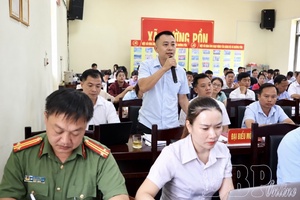
Educational institutions are required to publicly disclose the full list of fees, fee levels, legal bases for each fee, and collection periods on school notice boards, their electronic information portals, and at the beginning-of-year parent meetings. For fees outside the prescribed regulations, including voluntary contributions, donations, and socialized funding, implementation must be based on the principle of voluntariness, with parents consulted and their consensus obtained before implementation.
Nguyễn Thanh Tùng, Head of the Division of Culture and Social Affairs of Điện Biên Phủ ward, said: “We have required schools to strictly comply with regulations on financial revenue and expenditure at the beginning of the academic year and to publicly and transparently disclose fees in accordance with the guidelines. The collection of fees outside the regulations and the organization of tutoring or extra classes in violation of regulations are strictly prohibited.”
.jpg)
To strengthen the management of fees collected at the beginning of the academic year, the Department of Education and Training has requested the People’s Committees of communes and wards and affiliated units to strictly implement regulations on fees at public educational institutions in the 2026-2027 academic year. Localities are strengthening information dissemination, communication, dissemination and thorough implementation of directives on rectifying the collection and expenditure of fees among educational institutions and educational management agencies. Schools are stepping up communication and dissemination efforts so that parents, parent representative boards, and teachers clearly understand and properly comply with the regulations.
Funding for the operation of parent representative boards must comply with the Charter of Parent Representative Boards issued together with Circular No.55/2011/TT-BGDDT dated November 22, 2011, of the Ministry of Education and Training. Educational institutions are responsible for monitoring and promptly preventing the misuse of the name of parent representative boards to collect money in violation of regulations.
Parent representative boards may only collect fees that directly serve their activities as prescribed. They must not collect money for security guards and protection of school facilities, ensuring school security, looking after students’ vehicles, classroom cleaning, school cleaning, or rewarding school administrators, teachers, and staff. They must not collect money to purchase machinery or equipment for schools or classrooms, or for administrators, teachers, and staff; provide support for management, teaching, or educational activities; or repair, upgrade, or construct new school facilities, among other purposes.
With close direction from Party committees and authorities at all levels, and with the cooperation of relevant agencies and educational institutions, together with the consensus of students’ parents, Điện Biên is determined to build a fair and humane educational environment, ensuring the legitimate rights and interests of students and parents. This will provide a foundation for schools to strive to achieve their goals of quality teaching and learning and to build a healthy, fair, and responsible educational environment.
Quang Hưng
.jpg)
.jpg)
.jpg)
.jpg)
.jpg)
.jpg)
.jpg)
.jpg)
.jpg)
.jpg)
You have 500/500 characters left
Please enter 5 or more characters!!!