Keeping heritage alive, putting Điện Biên on tourism map

ĐBP - In today’s era of integration and development, preserving and promoting cultural heritage must go beyond simply safeguarding the past. Cultural traditions must be transformed into distinctive tourism experiences and recognized as invaluable resources for building a sustainable tourism brand that attracts visitors from Vietnam and abroad.

Home to 19 ethnic groups, each with its own distinctive cultural traditions, Điện Biên boasts a rich and diverse cultural heritage that makes the province an appealing destination for domestic and international tourists. The province currently has 463 intangible cultural heritage elements across seven categories, including 24 listed in Vietnam’s National Inventory of Intangible Cultural Heritage and two inscribed by UNESCO.

Phạm Văn Thăng, Head of the Tourism Management Division under the Department of Culture, Sports and Tourism, said: “The cultural sector has been focusing on promoting the use of cultural heritage in tourism development, gradually creating tourism products that reflect Điện Biên’s distinctive identity. We are also working to strengthen the role of local communities, recognizing residents as central to preserving, safeguarding and introducing traditional cultural values to visitors. These efforts help make local tourism more attractive and sustainable.”

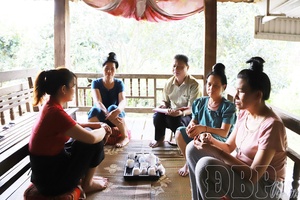
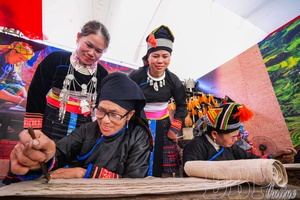
Recognized as national intangible cultural heritage in 2024, the art of decorating traditional clothing of the Lao ethnic group in Núa Ngam commune offers promising opportunities for sustainable tourism development. In this effort, the Nang Bua Brocade Cooperative has become a key link between heritage preservation, tourism development and livelihood creation.
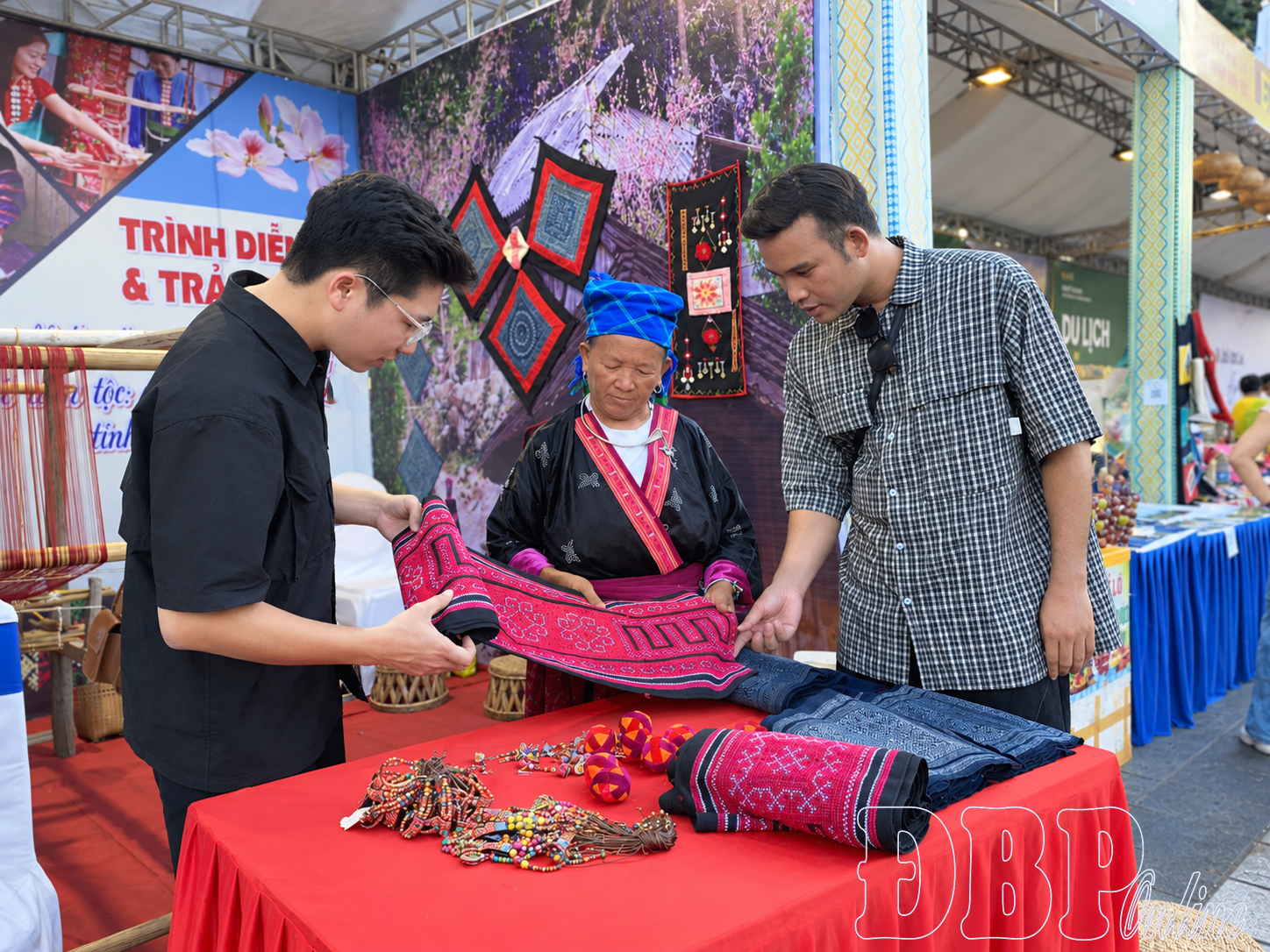
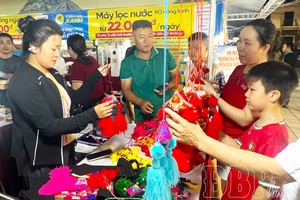
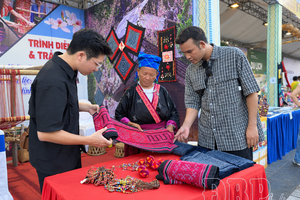
Visitors explore traditional patterns on Hmông ethnic clothing.

Hoàng Yến Vy, a resident of Na Sang village in Núa Ngam commune, said: “Being part of the Nang Bua Brocade Cooperative has allowed me not only to learn weaving techniques from older generations of women but also to develop the skills to introduce our products to visitors. Seeing tourists appreciate and buy brocade items that I have woven with my own hands makes me even prouder of my ethnic identity and more determined to preserve our traditions.”

Since the beginning of 2026, the Nang Bua Brocade Cooperative has welcomed more than 2,500 visitors for tours and hands-on experiences and sold hundreds of brocade products. Its members now earn a stable income of at least VND 10 million per month.

These encouraging results have injected new energy into the community, motivating local Party committees, authorities and residents to preserve their craft and pass their skills on to younger generations. Linking heritage with experiential tourism not only opens up a path to sustainable economic development but also turns brocade products into memorable souvenirs of the northern highlands.

As modern lifestyles and cultural exchanges reshape communities, many traditional values in villages across the province face the risk of disappearing. In Sính Phình, however, the Hmông khèn, a traditional reed-pipe instrument, continues to be cherished and preserved by local residents, who are gradually turning it into a distinctive tourism asset. For the Hmông people here, the sound of the khèn is more than the music of the mountains and forests; it expresses their spirit and pride, passed down through generations.

The art of making and performing the Hmông khèn in Điện Biên province was recognized as national intangible cultural heritage in 2022, providing an important foundation for the locality to harness its cultural resources and promote sustainable tourism.

Meritorious Artisan Sình A Tâu, from Village 2 in Sính Phình commune, said: “To spread our traditional culture and prevent the sound of the khèn from fading over time, I established the Sính Phình commune khèn ensemble more than 10 years ago. In addition to practicing, we perform at spring festivals and cultural exchanges to share our traditions and teach younger generations.”

Thanks to the dedication and perseverance of artisan Sình A Tâu and the Sính Phình khèn ensemble, the vibrant sound of the Hmông khèn remains an integral part of community life in Tủa Chùa.

Amid the province’s rugged mountain landscape, the image of an elderly artisan patiently teaching young people each rhythm of the khèn and every step of its accompanying dance stands as a powerful symbol of devotion and faith in the future of cultural heritage. Dedicated cultural practitioners such as Tâu serve as vital links between generations, preserving traditional knowledge for the future while helping transform the beauty of Hmông khèn music and dance into an engaging tourism experience that brings the cultural heritage of the Northwest highlands to a wider audience.

With its vast and colorful cultural heritage, Điện Biên is gradually demonstrating the economic potential of its own traditions. This vitality can be seen in the many distinctive forms of heritage that local communities cherish, preserve and pass down from one generation to the next.

One notable example is xòe Thái, the traditional dance of the Thai people, inscribed by UNESCO on the Representative List of the Intangible Cultural Heritage of Humanity. Its circular dances embody a spirit of solidarity and togetherness. Other distinctive traditions include the intricate art of decorating Lao ethnic clothing, the meticulous embroidery of Hmông women, and the traditional knowledge involved in making khẩu xén and chí chọp cakes, chewy and fragrant specialties of the White Thai people.

Each of these traditions preserves the essence of the past while increasingly serving as a distinctive tourism product, attracting large numbers of domestic and international visitors who come to explore and experience local culture firsthand.

In the coming years, Điện Biên will continue strengthening policies that link heritage preservation with livelihoods, encourage communities to take the lead in safeguarding their traditions, attract investment, improve infrastructure and develop plans for key heritage areas.

By turning heritage into an asset, the province aims to reinforce its distinctive identity and build momentum to become a leading tourism hub in Vietnam’s Northwest, contributing to local socioeconomic development.

Nhật Oanh
Comment

You have 500/500 characters left

Please enter 5 or more characters!!!

Recent news

  • 'Keeping heritage alive, putting Điện Biên on tourism map

    Keeping heritage alive, putting Điện Biên on tourism map

    TRAVEL -
    ĐBP - In today’s era of integration and development, preserving and promoting cultural heritage must go beyond simply safeguarding the past. Cultural traditions must be transformed into distinctive tourism experiences and recognized as invaluable resources for building a sustainable tourism brand that attracts visitors from Vietnam and abroad.
  • 'Building trust through safer, better school meals

    Building trust through safer, better school meals

    SOCIAL AFFAIRS -
    ĐBP - School meals play an important role in nurturing students, supporting their health and promoting their all-round development. Ensuring the safety and quality of these meals is therefore a priority for schools across Điện Biên province, helping protect students’ health and providing a solid foundation for their learning.
  • 'Standardizing student data in digital environments

    Standardizing student data in digital environments

    SOCIAL AFFAIRS -
    ĐBP - To manage education effectively on digital platforms, it is essential, first and foremost, to possess accurate, complete, and consistent data. In Điện Biên, educational institutions are focusing on reviewing, updating, and synchronizing student information on the sector’s database system.
  • 'Tightening food safety controls

    Tightening food safety controls

    SOCIAL AFFAIRS -
    ĐBP - Food quality is determined from the selection of ingredients and processing to product origin verification. In Điện Biên, production facilities, business establishments, and cooperatives are progressively tightening procedures and heightening responsibility across every phase of production and goods distribution.
  • 'Beyond classrooms: Teaching students to stay safe from fires

    Beyond classrooms: Teaching students to stay safe from fires

    SOCIAL AFFAIRS -
    ĐBP - With potential fire and explosion hazards posing risks at educational institutions, authorities across Điện Biên province are stepping up fire prevention and firefighting efforts through a range of practical activities. By combining awareness campaigns with hands-on demonstrations and skills training, officials, teachers and students are gradually improving their understanding of fire safety and their ability to respond to emergencies, helping create a safer school environment.
  • 'Spreading joy, connecting love

    Spreading joy, connecting love

    SOCIAL AFFAIRS -
    ĐBP - Amid busy work schedules, activities celebrating the Vietnamese Women’s Day on October 20 offer an occasion for women to set aside daily worries, gather, interact, and share life experiences. Each activity carries its own unique character, yet all deliver joy, helping women build confidence and deeply appreciate solidarity and affection in life.
  • 'Điện Biên’s National Assembly deputies contribute opinions to refine laws in healthcare and social welfare

    Điện Biên’s National Assembly deputies contribute opinions to refine laws in healthcare and social welfare

    NEWS - POLITICS -
    ĐBP - On October 21, during the group discussion within the framework of the 2nd Session of the 16th National Assembly, deputies of the Điện Biên provincial National Assembly Deputy Delegation contributed opinions to the draft laws amending and supplementing several articles of the Law on Children, the Law on Persons with Disabilities, the Law on Medical Examination and Treatment, the Law on Pharmacy, the Law on the Elderly, and the Law on Health Insurance.
  • 'Giving residents a voice, turning concerns into action

    Giving residents a voice, turning concerns into action

    NEWS - POLITICS -
    ĐBP - Direct dialogue with residents is a practical way for local authorities to listen to their concerns and aspirations, identify emerging issues in a timely manner, and address problems arising in everyday life. In Mường Pồn commune, dialogue has enabled authorities to hear and consider numerous requests concerning infrastructure, social welfare and agricultural production, assign specific follow-up responsibilities, and strengthen government accountability, public participation and consensus among residents.
  • 'Connecting trade, expanding markets

    Connecting trade, expanding markets

    ECONOMY -
    ĐBP - Under the theme “Điện Biên - A Trade Bridge, Reaching Out to the World,” the 2026 Điện Biên International Trade Fair unlocks opportunities for domestic and international enterprises to connect, promote products, seek business partners, and expand consumer markets.
  • 'People's high consensus clears way for expressway project

    People's high consensus clears way for expressway project

    ECONOMY -
    ĐBP - These days, in Lịch Cang village, Mường Lạn commune, machinery and labor forces are mobilized to level ground, preparing to build a resettlement area serving households affected during the implementation of the Sơn La - Điện Biên - Tây Trang Border Gate Expressway project (Phase 1).
  • 'Điện Biên approves investments totaling VND 7,500 billion

    Điện Biên approves investments totaling VND 7,500 billion

    ECONOMY -
    ĐBP - Marking a fresh stride in regional economic connectivity and cooperation, the 2026 International Investment Promotion Conference between Điện Biên province (Vietnam), Luang Prabang province (Laos), and Yunnan province (China) - held on the morning of October 19 at the Event Center of Mường Thanh Grand Điện Biên Phủ Hotel (Điện Biên Phủ ward), Điện Biên province - opened up opportunities for cooperation and accelerated the harnessing of each locality’s potentials and strengths. At the conference, Điện Biên province presented 20 Investor Approval Decisions with a total investment capital of approximately VND 7,500 billion.