



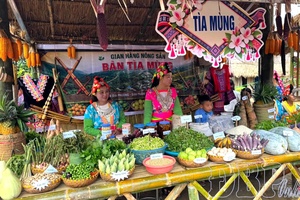
September 2, 2026, marked a new milestone in community tourism development in Pu Nhi commune when Tù Lu - Tìa Ló Community Tourism Village officially launched its community tourism product. Drawing from cultural values preserved in everyday life, local residents have begun packaging them into experiences for visitors, opening a fresh economic avenue grounded in the village’s inherent strengths.
Chá A Mua, Head of Tìa Ló village, noted that the village concentrates on showcasing the signature cultural traits of the Hmông ethnic group. Forging, brocade weaving, traditional wine brewing, culinary specialties, and folk games were chosen as the core experiential activities.
According to Chá A Mua, the key to product development is preserving authentic local characteristics so tourism activities remain integrated with community life. Traditional trades maintained over generations now have dedicated spaces for demonstration; dishes commonly featured in everyday meals and Hmông festive celebrations are served to tourists; and folk games are organized into participatory experiences. “These are traditions our villagers maintain daily. When guests arrive, locals demonstrate and guide them to take part. Through this, residents earn extra income while finding renewed motivation to preserve our ethnic group’s traditional crafts and culture,” Chá A Mua shared.
.jpg)
In A Pa Chải, tourism is being developed in connection with border areas. On July 13, 2026, the provincial People’s Committee issued Decision No.1539/QĐ-UBND recognizing the A Pa Chải Flagpole (Sín Thầu commune) as a tourist attraction. This provides the administrative ground for the locality to progressively organize and refine services and experiential activities, turning the Flagpole area and the Việt Nam - Laos - China Border Junction Marker into a distinctive tourism product. The A Pa Chải Flagpole was inaugurated on May 7, 2025, commemorating the 71st anniversary of the Điện Biên Phủ Victory. The monument stands at an elevation of 1,432m, roughly 1.4km from the tri-border junction marker, accessed via a 519-stone-step stairway. The A Pa Chải Flagpole alongside the Việt Nam - Laos - China tri-border marker atop Khoang La San Peak forms a defining highlight along journeys exploring the nation’s westernmost territory. Since the flagpole’s construction, travelers heading to Sín Thầu to conquer the westernmost point have steadily increased. Annually, the commune welcomes thousands of visitor arrivals.
Đàm Văn Cường, Vice Chairman of the Sín Thầu commune People’s Committee, shared: alongside landscape appreciation, the commune emphasizes connecting tourism products with the culture and daily life of local ethnic communities. When tourists extend their stays, residents have greater opportunities to provide accommodation, dining, and cultural interpretation services, generating supplemental income and facilitating the preservation of traditional values. Accommodation facilities, homestays, and dining services have been established locally to cater to guests. Several households have begun participating directly in tourism activities, from hosting overnight visitors and preparing traditional cuisine to presenting Hà Nhì cultural heritage.
Beyond village- and border-oriented offerings, Điện Biên’s tourism space is also expanding toward enhanced nighttime experiences. Mường Thanh Walking Street (Điện Biên Phủ ward) stands out as a new attraction in the provincial urban center. This pedestrian area provides an added venue for recreation, culinary exploration, shopping, and cultural experiences following daytime tours of historical relics. Establishing the walking street also contributes to reshaping urban tourism organization. Whereas travelers’ itineraries previously concentrated on historical sites, museums, A1 Hill, General De Castries Bunker, or landmarks associated with the Điện Biên Phủ Victory, nocturnal spaces offer further options for visitors to continue exploring, stay overnight, and spend locally.
Bùi Hoàng Anh, a tourist from Hải Phòng city, shared: “I visited Điện Biên about two years ago, focusing primarily on historical relics. Returning this time, I noticed Điện Biên offers many more experiential destinations, including the walking street with evening activities like strolling, enjoying local food, shopping, and learning about indigenous culture. Such experiences make the journey far richer and encourage me to stay longer.”
Under provincial tourism development orientations through 2030, Điện Biên strives to ensure that all 45 out of 45 communes and wards develop distinct tourism products, promote agritourism models, and raise the average length of stay to approximately three days. To accomplish this target, localities have concentrated on harnessing distinctive strengths, building products tied to indigenous culture, natural landscapes, community life, and characteristic regional traits. Alongside introducing new products, visitor services are being progressively augmented, diversifying experiences and improving the capacity to retain tourists for longer stays.
Quang Long

.jpg)
.jpg)


.jpg)


.jpg)

.jpg)
.jpg)
.jpg)
.jpg)
.jpg)
You have 500/500 characters left
Please enter 5 or more characters!!!