Orientation for staffing commune-level officials, civil servants, and public employees

ĐBP - Currently, the rearrangement and merger of commune-level administrative units across the province are being carried out according to the planned roadmap. From determining restructuring plans to solving staffing issues, all levels and sectors are working systematically and scientifically, with the highest level of political determination.

Following the Điện Biên provincial Party Committee’s resolution on the plan to conclude district-level operations, restructure and merge commune-level administrative units, and organize the political system, localities are now focusing on leading and implementing tasks in compliance with regulations and timelines. The goal is to ensure that newly established commune and ward administrative structures operate smoothly, efficiently, effectively, and serve the people in a close and responsive manner. Among these, developing staffing plans at the commune level are being conducted swiftly yet cautiously, ensuring alignment with the Party’s and the State’s legal regulations.

The provincial Party Committee’s Commission for Organization has taken the lead in drafting a temporary regulation on commune-level leadership standards (including a list of positions and titles for staffing commune-level leadership and management roles). The draft regulation has been circulated for feedback from the provincial Party Committee, and relevant agencies and localities. It is currently being finalized and is expected to be issued by the Standing Board of the provincial Party Committee in May 2025. This temporary regulation will serve as the basis for organizing the new commune-level leadership staff once the relevant authority officially establishes the new units.

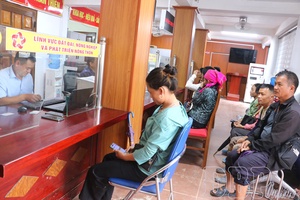
A “One-stop-shop” administrative officer of the Nậm Pồ district People’s Committee guides citizens through administrative procedures.

At present, the central government has not issued specific commune-level staffing quotas. According to guidance, the expected staffing level for specialized Party work (including staff for advisory bodies, Party secretaries, and deputy secretaries of Party committees) is about 15-17 staff members per commune or ward Party committee; for those located in district or city political centers, around 20. Projected allocations are: communes with fewer than 400 Party members - 15 positions; 500 to under 800 - 16 positions; more than 800 - up to 17 positions.

For administrative agencies, the government’s orientation is for each commune to average 32 staff members (including those in leadership roles for People’s Councils and People’s Committees). Thus, for an expected 45 communes and wards in the province, the total staffing for local governments is estimated at 1,440 positions.

Staffing allocation criteria include: Communes/wards with an area or population (or both) under 200% of the standard will receive 28 staff positions; depending on the size and characteristics of each unit, additional staff may be added. For every 50% increase in area or population, one additional staff position is granted per criterion; border communes are allocated one additional position; communes formed from the merger of three communes or townships are granted one extra position; communes with complex security conditions receive one additional position; and reorganized wards are allocated three additional positions.

Total staffing should not exceed 36 positions per commune and 39 per ward, while the overall province-wide limit of 1,440 staff for commune-level governance remains in place after the five-year stabilization period.

To ensure Party committees in communes and wards can function immediately upon establishment, all existing district-level staff will be temporarily reassigned to commune-level units. Current district-level leadership and management personnel will form the core of the new commune-level administrative teams. Simultaneously, there will be plans and training roadmaps for current commune and ward officials to meet standards and requirements for working in the new administrative structures. After the new communes and wards begin operating, the province will annually assign staffing based on each unit’s size, socio-economic conditions, and unique characteristics.

In parallel with organizing commune-level officials and staff, the province is also addressing the policies and benefits of civil servants, public employees, and workers during the streamlining of the administrative apparatus, particularly at the two levels of government. Specifically, the Government has issued Decree No.178/2024/NĐ-CP (December 31, 2024) and Decree No.67/2025/NĐ-CP (March 15, 2025) to resolve entitlements for personnel affected by the restructuring. These entitlements will be implemented following the official decision to conclude district-level administrative operations, starting July 1, 2025.

In Nậm Pồ district, there are currently 120 district-level civil servants and 61 public employees; at the commune level, there are 297 civil servants and 179 part-time workers. To ensure effective staffing during the commune-level administrative restructuring, the district Party Committee’s Sub-commission for Organization has worked with relevant departments to review and assess the situation and aspirations of staff, ensuring that all policies are properly applied. This approach helps build consensus among public servants and lays a strong foundation for building a local government that is close to the people and able to respond effectively to public needs, thereby promoting socio-economic development and improving people’s lives.

Sầm Phúc
Comment

You have 500/500 characters left

Please enter 5 or more characters!!!

Recent news

  • 'Racing to complete new coffee and macadamia planting season

    Racing to complete new coffee and macadamia planting season

    ECONOMY -
    ĐBP - In implementing the provincial People’s Committee’s Plan No.1850/KH-UBND on new coffee and macadamia planting, localities across Điện Biên have launched simultaneous campaigns and accelerated planting operations since late June. The newly planted areas are now being urgently completed, with efforts focused on meeting the plan within the appropriate planting season and ensuring the targets are achieved.
  • 'Vietnamese language training for students entering Grade 1

    Vietnamese language training for students entering Grade 1

    SOCIAL AFFAIRS -
    ĐBP - During early August days, across Vietnamese language enhancement classes in Điện Biên province, ethnic minority children preparing to enter grade 1 received guidance on numerous basic skills - ranging from holding pens, reading, writing, and recognizing letters to communicating and building learning habits - helping them gain confidence to step into new learning environments.
  • 'Điện Biên enriches its OCOP product portfolio

    Điện Biên enriches its OCOP product portfolio

    ECONOMY -
    ĐBP - Building on its potential and advantages, Điện Biên is stepping up the development of One Commune One Product (OCOP) products in a direction that emphasizes diversification, quality improvement and greater added value. These efforts are gradually enriching the province’s OCOP product portfolio, strengthening product brands, expanding consumer markets and contributing to rural economic development.
  • 'Party committees and local authorities enhance dialogues with people

    Party committees and local authorities enhance dialogues with people

    NEWS - POLITICS -
    ĐBP - Direct dialogues between party committees, local authorities, and the people represent a crucial solution to promote grassroots democracy and resolve emerging difficulties and obstacles directly from residential areas. Through dialogue conferences, public thoughts and aspirations are heard and answered openly, forging consensus in deploying guidelines and policies to elevate management and operational efficiency while driving socio-economic development.
  • 'Awakening the will to escape from poverty

    Awakening the will to escape from poverty

    SOCIAL AFFAIRS -
    ĐBP - Across numerous highland villages, life for many households remains filled with shortages, yet with timely companionship and support from the Party, State, and social organizations, many families have gained additional conditions to develop livelihoods.
  • 'Điện Biên delegation pays tribute to Xaysomphone Phomvihane

    Điện Biên delegation pays tribute to Xaysomphone Phomvihane

    NEWS - POLITICS -
    ĐBP - On August 10, a delegation from Điện Biên province led by Trần Tiến Dũng, Member of the Party Central Committee, Secretary of the provincial Party Committee, and Head of the provincial National Assembly Deputy Delegation, visited the Lao Embassy in Hà Nội to pay tribute and write the condolence book in memory of Xaysomphone Phomvihane, President of the National Assembly of the Lao People’s Democratic Republic.
  • 'Boosting credit growth to serve socio-economic development

    Boosting credit growth to serve socio-economic development

    ECONOMY -
    ĐBP - Amid an environment where the socio-economic context continues to maintain positive growth momentum, the banking sector across Điện Biên province plays a crucial role in supplying financial resources for production, business, and development programs.
  • 'Mường Chà commune Police with “Digital Popular Education” movement

    Mường Chà commune Police with “Digital Popular Education” movement

    SOCIAL AFFAIRS -
    ĐBP - Currently, in Mường Chà commune, Điện Biên province, many elderly people have never used smartphones, and many remain unfamiliar with cashless payments. Therefore, Mường Chà commune police forces determined that achieving successful digital transformation requires first helping residents understand, know, and feel confident using technology.
  • 'Youths active in remote villages

    Youths active in remote villages

    SOCIAL AFFAIRS -
    ĐBP - Amid highland mountains and forests, the green color of volunteer shirts presence on hill fields, rural roads, social security activities, and journeys bringing digital transformation to every village.
  • 'Turning culture into a development resource

    Turning culture into a development resource

    CULTURE - SPORTS -
    ĐBP - Designating culture as a spiritual foundation and endogenous resource for sustainable development, Điện Biên province deployed numerous solutions to elevate the spiritual and cultural life of the people, preserving and promoting traditional values, through which cultural values spread deeply across the community, contributing to building a rich identity and developing image for Điện Biên.
  • 'Silent footsteps find martyrs’ remains

    Silent footsteps find martyrs’ remains

    NEWS - POLITICS -
    ĐBP - There are marches without gunfire, only silent footsteps tracing memories to find martyrs still lying behind. Amid the mist atop Pha Đin peak, the journey gathering 2 martyrs’ remains within the “500-day-and-night Campaign to boost searching, gathering, and identifying martyrs’ remains” represents a journey of gratitude, rediscovering names for fallen soldiers.
  • 'Điện Biên synchronously renovates park, greenery, and sidewalk system

    Điện Biên synchronously renovates park, greenery, and sidewalk system

    SOCIAL AFFAIRS -
    ĐBP - The system of parks, trees, and sidewalks plays a crucial role in creating landscapes, enhancing living quality, and forming a modern urban appearance. In Điện Biên province’s Điện Biên Phủ and Mường Thanh wards, despite serving as the provincial development core, the system of trees, parks, and landscape infrastructure exhibits numerous limitations requiring synchronous renovation under planning to satisfy green, smart, and sustainable urban construction requirements.
  • 'OCOP: Điện Biên’s tourism ambassadors

    OCOP: Điện Biên’s tourism ambassadors

    TRAVEL -
    ĐBP - After years of implementation, the One Commune One Product (OCOP) Program has encouraged many producers to improve product quality, refine production processes, build brands and expand markets. As tourism increasingly shifts toward deeper, experience-based development, integrating OCOP products into tourist experiences is seen as a way to create more sustainable added value for both products and destinations.