Điện Biên Provincial Party Committee urges Tuần Giáo to accelerate economic growth

ĐBP – The Điện Biên Provincial Party Committee has asked Tuần Giáo District to continue accelerating growth rate and restructuring its economy according to the resolutions set by the province and district, in order to fully tap into its potential as the province's gateway.

Mùa A Sơn, Permanent Deputy Secretary of the Provincial Party Committee gave this directive during a meeting with Tuần Giáo District leaders on Wednesday. The meeting discussed the province’s socio-economic development over the past seven months, the disbursement of public investment funds, the implementation of national target programmes, and the rural power supply project using the national grid.

Also attending the meeting were Phạm Đức Toàn, Member of the Standing Committee of the Provincial Party Committee and Permanent Vice Chairman of the Provincial People’s Committee; Lò Văn Mừng, Member of the Standing Committee, Head of the Provincial Mass Mobilisation Committee, and Phạm Khắc Quân, Member of the Standing Committee and Head of the Provincial Party Committee’s Organisation Department.
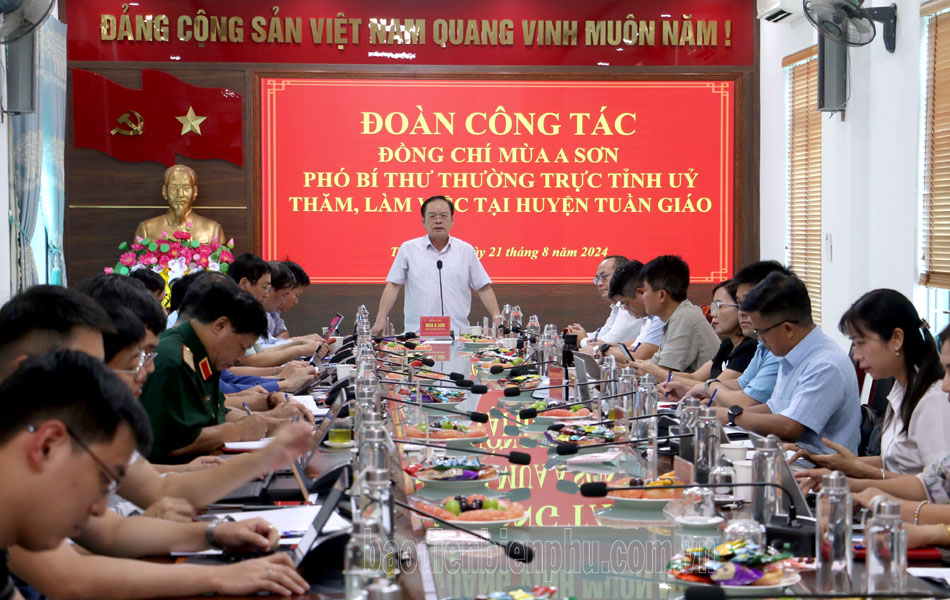
Mùa A Sơn, Permanent Deputy Secretary of the Provincial Party Committee, concludes the working session with Tuần Giáo District’s leaders.

In the first seven months of the year, Tuần Giáo District’s socio-economic development indicators have generally met the set goals.

The district effectively continued its agricultural restructuring plan, focusing on the development of key crops and livestock. As of July 31, 2024, the district had disbursed 53.4 per cent of its allocated public investment funds, while the national target programmes reached 30.2 per cent of the allocated funds.

The district also emphasised Party building and strengthening the political system, with the rate of new Party member admissions reaching 72.76 per cent of the province’s target.

Regarding the rural power supply project using the national grid, the Tuần Giáo District People's Committee has submitted and approved the contractor selection plan. The district completed a comprehensive review of land occupation, land types, and forest status at the locations of the pole foundations, medium-voltage lines, substations, and low-voltage lines. The technical design plan minimises the impact on existing forests and agricultural-forestry land used by the local population.
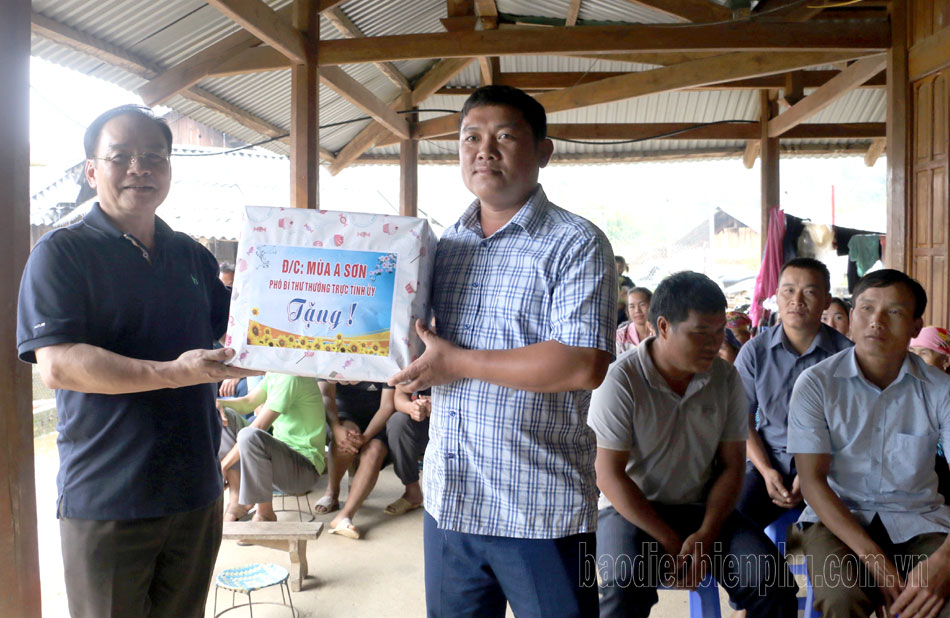
Mùa A Sơn, Permanent Deputy Secretary of the Provincial Party Committee, presents gifts to residents of Sông La Village in Tỏa Tình Commune.

The provincial Party Committee proposed solutions to help Tuần Giáo District overcome difficulties in implementing public investment projects and national target programmes.

It directed the district to reduce the target for the use of production forest land from 17,710 hectares to over 14,010 hectares, a decrease of over 3,690 hectares compared to the original land use plan.

For the rural power supply project, it said the district needs to avoid placing pole foundations on forest land and two-crop rice fields as much as possible. High poles should be used to ensure safety height, and staggered cross-arms with insulated wires should be utilised for medium-voltage lines crossing forest land.

The district should accelerate the completion of bidding documents, ensuring that the tender packages are reasonable and suitable for the capacity and conditions of local contractors.

Additionally, the district should focus on piloting a community-based tourism model in the area. It is also necessary to review and update planning, and rotate personnel in preparation for the Party Congress at all levels for the 2025-2030 tenure, it added.

Permanent Deputy Secretary Sơn called on Tuần Giáo District to concentrate and take decisive action in implementing public investment projects and national target programmes, addressing the issues and limitations identified during the working session. He also emphasised the need to attract investors and leverage local strengths.

Mùa A Sơn, Permanent Deputy Secretary of the Provincial Party Committee, inspects the coffee and macadamia intercropping model in Chế Á Village, Tỏa Tình Commune, Tuần Giáo District.

Regarding the rural power supply project using the national grid, the district People's Committee was instructed to have relevant departments and agencies expedite the completion of investment procedures to ensure that the project starts on time and meets quality standards.

Regular updates on the overall progress of the projects should be reported to the province.

Earlier that day, Sơn conducted on-site inspections of the proposed 35kV medium-voltage and 0.4kV low-voltage power lines for the rural power supply project in Sông La Village, the coffee and macadamia intercropping model in Chế Á Village, Tỏa Tình Commune, and the Ngọc Linh and Lai Châu ginseng cultivation models in Ten Hon Village, Tênh Phông Commune.

By Anh Nguyễn
Comment

You have 500/500 characters left

Please enter 5 or more characters!!!

Recent news

  • 'Traditional sports spread cultural colors of Hmông ethnic group

    Traditional sports spread cultural colors of Hmông ethnic group

    CULTURE - SPORTS -
    ĐBP - Thrilling tug-of-war and stick-pushing matches, deft pa pao throws, the resonant buzz of tù lu spinning tops, and intense concentration in every crossbow shooting round... All came together to forge a distinct appeal for the sporting competitions at the 4th Hmông Ethnic Cultural Festival. Through each contest, traditional sports delivered exciting moments, captivating residents and visitors while helping spread the cultural beauty of the Hmông people.
  • 'Closing ceremony of 4th Hmông Ethnic Cultural Festival

    Closing ceremony of 4th Hmông Ethnic Cultural Festival

    CULTURE - SPORTS -
    ĐBP - On the evening of October 11, at Mường Thanh Walking Street in Điện Biên Phủ ward, the Ministry of Culture, Sports and Tourism coordinated with the Điện Biên provincial People’s Committee to organize the Closing Ceremony of the 4th Hmông Ethnic Cultural Festival, 2026. Following three vibrant days featuring distinctive activities, the festival concluded with great success, leaving profound impressions on local residents and tourists.
  • 'Điện Biên improves domestic water quality

    Điện Biên improves domestic water quality

    SOCIAL AFFAIRS -
    ĐBP - From invested and upgraded water supply facilities to pipeline systems extending into residential areas, Điện Biên is progressively bringing clean water closer to the people. Alongside expanding supply networks, the province prioritizes water resource protection, elevating treatment quality, and strengthening surveillance, aiming to ensure safe, stable domestic water sources and contributing to improved public health and quality of life.
  • 'Adding diverse experiences for visitors

    Adding diverse experiences for visitors

    TRAVEL -
    ĐBP - Điện Biên is refreshing its tourism offerings with experiences linked to indigenous culture, community life, border regions, and urban nightlife spaces. These new products not only provide visitors with more choices, but also offer more intimate perspectives on the land and people of Điện Biên, helping lengthen stays and heighten destination appeal.
  • 'The Party’s strong political will and wise leadership

    The Party’s strong political will and wise leadership

    NEWS - POLITICS -
    ĐBP - On October 10, 1949, the Lai Châu provincial Party Affairs Committee - now the Điện Biên provincial Party Committee - was established. This represented a milestone laying the groundwork for revolutionary movements across the locality to receive unified leadership.
  • 'Colors of Hmông ethnic traditional crafts

    Colors of Hmông ethnic traditional crafts

    CULTURE - SPORTS -
    ĐBP - Within the framework of the 4th Hmông Ethnic Cultural Festival, taking place from October 9 to 11 in Điện Biên, localities have brought forth craft demonstration spaces rich in identity. Every product and practical maneuver contributes to showcasing the cultural beauty and vitality of handicrafts preserved across generations by the Hmông people.
  • 'The joy of a grand cultural celebration

    The joy of a grand cultural celebration

    CULTURE - SPORTS -
    ĐBP - The lively sound of the Hmông khèn flute echoes through the mountains and forests of Điện Biên, blending with the excitement building ahead of the 4th Hmông Ethnic Culture Festival 2026. Artisans rehearse with passion, while villagers bustle about preparing to welcome visitors. Behind the flute’s rich, haunting melodies lies pride in ethnic identity and a heartfelt invitation to friends and travelers to join in the festivities.
  • 'Exciting sports competitions at 4th Hmông Ethnic Cultural Festival

    Exciting sports competitions at 4th Hmông Ethnic Cultural Festival

    CULTURE - SPORTS -
    ĐBP - Within the framework of the 4th Hmông Ethnic Cultural Festival, sporting events officially kick off on October 9. At this point, athletes from participating delegations are swiftly stabilizing their contingents, checking registration dossiers, and preparing uniforms and equipment, looking forward to spirited competitions.
  • 'Honoring cultural identity of Hmông ethnic group

    Honoring cultural identity of Hmông ethnic group

    CULTURE - SPORTS -
    ĐBP - The 4th Hmông Ethnic Cultural Festival in 2026 takes place from October 9 to 11 in Điện Biên province. Nearly 800 artisans, performers, and athletes from 11 provinces - including Tuyên Quang, Phú Thọ, Thái Nguyên, Sơn La, Cao Bằng, Lào Cai, Thanh Hóa, Nghệ An, Đắk Lắk, Điện Biên, and Lai Châu - gather together. This is not only a cultural celebration, but also an occasion to affirm the enduring vitality of ethnic identity within the nation’s developmental stream.
  • 'Hmông people take charge of their tourism future

    Hmông people take charge of their tourism future

    TRAVEL -
    ĐBP - Drawing on the cultural and natural assets embedded in everyday life, Hmông communities in Điện Biên province are gradually changing the way they think and work to develop community-based tourism. The transformation is reflected in their proactive efforts to improve their villages, preserve traditional culture and work together to protect the landscape and environment.