



Part 4: From an administrative government to a service-oriented government
The manner in which authorities across administrative tiers receive and resolve tasks is undergoing substantive transformations toward proactiveness, grassroots-level proximity, and utilizing the service delivery effectiveness for citizens and enterprises as the core benchmark.
From executing assigned tasks to proactive resolution
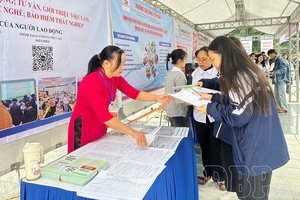
At the Public Administrative Service Center of Điện Biên province, bulky stacks of paper dossiers have been replaced by smartphone operations. Utilizing digital identity accounts on VNeID, residents and enterprises can seamlessly log in, declare information, submit applications, track progress, and receive administrative outcomes entirely online.
A representative of Thông Lan Technology Taxi Joint Stock Company arriving at the provincial Public Administrative Service Center to handle procedures for issuing an automotive passenger transport business license - including four-wheeled motorized vehicles - clearly sensed this modernization. The company representative noted that thanks to the “green lane” mechanism, processing time for this procedure was curtailed from four days down to 1.5 days. This compression enabled the business to finalize paperwork swiftly, manage business schedules proactively, and reduce waiting intervals.
.jpg)
Behind each online submission lies a shift in official working practices. Đỗ Thị Khuyên, Deputy Director of the provincial Public Administrative Service Center of Điện Biên, noted that online receipt coupled with the “green lane” mechanism accelerates processing times and cuts waiting periods for citizens and enterprises. Consequently, beyond receiving files, staff must proactively provide guidance, verify data, support applicants in finalizing dossiers, and closely track the entire handling workflow.
The two-tier local governance model confronts grassroots-level administrations with heightened demands for accountability. With numerous mandates devolved, commune-level cadres can no longer merely await guidelines from higher authorities. Alongside assigned authority, the commune tier must proactively organize implementation, assume responsibility for operational delivery and processing quality, and forge closer ties with the people on every concrete matter.
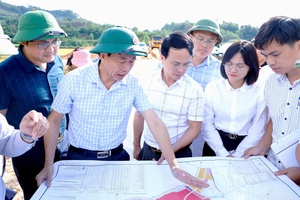
In Mường Ảng, the proactive approach of commune authorities goes beyond resolving administrative procedures. Under the new model, the commune tier serves as an active bridge coordinating with provincial agencies, directly accompanying enterprises and residents to transform economic potentials into tangible development resources.
Mường Ảng commune encompasses 1,963ha of coffee, of which 1,813ha represents commercial harvesting plantations, generating an annual yield of roughly 3,500 to 3,900 tons of green coffee beans. To secure stable market outlets and elevate bean value, Mường Ảng commune authorities proactively collaborated with departments and sectors to seek and connect prospective investors to survey and explore local investment opportunities. Hà Thị Thanh Tâm, Chairwoman of the Mường Ảng commune People’s Committee, stated: “The locality coordinated with departments and sectors to bring investors directly to survey the core coffee-growing zone of Mường Ảng. Simultaneously, the commune instituted supportive mechanisms to create maximum convenience regarding land allocation, infrastructure, and administrative procedures to attract key anchor projects.”
.jpg)
Thanks to this proactive posture, Mường Ảng commune attracted Detech Coffee Joint Stock Company to conduct field surveys across planting zones and select a plot of approximately 13ha in Na Luông village to invest in a deep-processing facility. Currently, the commune is coordinating with the company to implement site clearance, having disbursed compensation and site clearance support to 101 out of 113 affected households with a total value exceeding VND 5.8 billion.
Drawing from this concrete undertaking, the evolving role of grassroots-level governance in the new era becomes evident: proactively networking, collaborating, and clearing bottlenecks to maximize developmental resources. This also marks the vital distinction between “administrative control” and “public service.” Administrative management stops at the routine execution of statutory functions, whereas a service orientation requires authorities to deeply understand practical demands, coordinate proactively, and create optimal conditions for matters to be resolved effectively.
From changing workflows to tangible development outcomes
Alongside streamlining apparatuses and devolving extensive powers closer to the grassroots level, Điện Biên province is deploying solutions to enhance the investment climate and spur production and business. The “green lane” mechanism has been instituted across 26 provincial-level and 4 commune-level administrative procedures, focusing on domains that exert direct impacts on investment, production, and commercial operations. Many administrative procedures have experienced substantial time reductions: industry and trade cut processing time by up to 70%; culture, sports, and tourism saw a 50% decrease; health procedures were compressed by up to 70%; and within agriculture, environment, and land administration alone, seven procedures saw durations slashed by 43.8% to 72.2%.
.jpg)
After more than a year in operation, the two-tier governance restructuring in Điện Biên has reshaped organization and redefined accountability between administrative tiers. Crucially, it has been affirmed through concrete grassroots-level results: citizens resolve administrative procedures rapidly without repeated visits; cadres proactively travel down to hamlets and villages to verify emerging matters; and commune authorities take the initiative to connect and attract investors. A vivid testament is that during the first six months of 2026, the provincial People’s Committee approved investment policies and authorized project information for 12 projects totaling more than VND 27,350 billion in registered capital, including 3 FDI projects totaling over VND 14,005 billion; meanwhile, third-quarter GRDP was estimated at VND 8,115.59 billion, expanding 10.58% year-on-year.
These achievements in investment attraction, production, commercial trade, and GRDP growth illustrate positive momentum across the local economy during the rollout of the new governance structure.
A new governance framework is not measured solely by whether administrative machinery has completed restructuring or how many tasks have been decentralized. The genuine benchmark lies in the capacity to transform authority into accountability, translate accountability into tangible action, and generate concrete service outcomes for citizens and businesses. That is the journey from an administrative government to a service-oriented government that Điện Biên is progressively realizing from the grassroots level.
Tuấn Anh - Phạm Trung
.jpg)
.jpg)
.jpg)
.jpg)
.jpg)

.jpg)

.jpg)
.jpg)
.jpg)
.jpg)
.jpg)

You have 500/500 characters left
Please enter 5 or more characters!!!