Smooth handover in public projects after reorganization of administrative units

ĐBP - To improve investment management efficiency, local authorities in Điện Biên province have swiftly coordinated efforts to transfer the oversight of public projects following the implementation of a new two-tier government structure.

The handovers are being conducted transparently and in compliance with legal procedures, ensuring proper documentation and timelines. This process is expected to optimize investment capital use and enhance the functionality of public infrastructure supporting local socio-economic development.

An employee at the former project management and land development unit of Mường Chà district prepare complete documentation before handing projects over to relevant agencies.

In early July, shortly after the new administrative model came into effect, the former project management and land development unit of Mường Chà district handed over a series of key infrastructure projects to the newly established project management and land development unit of zone 4. These projects, funded by central government budgets, non-business capital, and national target programs, include infrastructure for transport, clean water access, education, and resettlement support for ethnic minority and mountainous communities. Many of these projects have been completed on schedule and have received final audits, playing a crucial role in improving living standards in remote areas.

Notable completed and transferred projects include the clean water supply systems in Xà Phình 1 and 2 hamlets (former Sá Tổng commune), the road from National Highway 6 to Cứu Táng hamlet, and the cultural house in Nậm Nèn 2 hamlet (Nậm Nèn commune). Several upgraded schools have also been handed over, including Na Sang Primary Boarding School for Ethnic Minorities, Nậm Nèn Secondary Boarding School for Ethnic Minorities, and Mường Tùng Secondary Boarding School for Ethnic Minorities. Larger projects such as the road from Háng Mùa Lừ hamlet to Sá Tổng commune center, and irrigation facilities in former Sa Lông and Hừa Ngài communes are nearing completion. These efforts come as the province pushes to disburse public investment funds and achieve socio-economic development goals for 2025. The handovers are instrumental in upgrading rural infrastructure, enhancing public service delivery, and narrowing development gaps between regions.

The project management and land development Unit of zone 4 is now accelerating the remaining construction progress, strengthening quality control, and finalizing audit documentation.

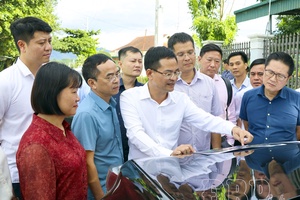
Officials from the project management and land development unit of zone 2 inspect a project during handover.

Under the 2021- 2025 plan to reorganize local government, the project management and land development unit of zone 2 is also taking over ongoing and completed projects in the former Điện Biên and Điện Biên Đông districts. Within the national target program for socio-economic development in ethnic minority and mountainous areas, the unit is receiving five completed and audited projects, seven completed but unaudited projects, and one ongoing project from the former Bureau of Economic Infrastructure and Bureau of Agriculture and Environment in Điện Biên Đông. Under the national target program for sustainable poverty reduction, the unit is accepting six audited projects, ten unaudited completed projects, and one ongoing project transferred from the former district Sub-department of Education and Training.

Trần Huy Hoàng, Deputy Director of the project management and land development unit of zone 2, explained: “Following directives from the provincial People’s Committee and relevant departments, all projects previously managed by district-level agencies are being transferred to the zone-level project management units. Projects from the former Điện Biên Đông district are categorized into two groups: ongoing and completed but unaudited. For ongoing projects, we must verify on-site progress and confirm completed components. The former units remain responsible for those parts. Our unit will take over and continue the unfinished components. For completed but unaudited projects, we only proceed with the handover if the legal documents are complete and eligible for final audit procedures.”

Project handover process is coonsidered a key to improving investment efficiency and infrastructure development.

Previously, on June 29, 2025, the provincial People’s Committee issued Decision No.1376, adjusting investor responsibilities for district-level projects to align with the restructuring of local government. Projects will be transferred “as-is” to the new managing units, including full legal and financial documentation, progress reports, and disbursement records. Handover documents must clearly outline used and remaining capital, completed workload, and execution status, enabling the receiving unit to proceed with implementation and audits. Receiving agencies must review and collect all necessary documents to ensure legal compliance. Former managing agencies are required to finalize paperwork and closely coordinate during the transition. Relevant provincial departments have been tasked with guiding and supervising the process to ensure timely implementation and effective use of public funds.

These handovers mark a critical step in streamlining public investment management following administrative reform. Thanks to strong coordination among all stakeholders, especially the zone-level project management and land development units, the process is steadily advancing. This lays a solid foundation for continued execution, final audits, and long-term utilization of public infrastructure across Điện Biên province.

Phạm Quang

Comment

You have 500/500 characters left

Please enter 5 or more characters!!!

Recent news

  • 'Helping OCOP producers break into bigger markets

    Helping OCOP producers break into bigger markets

    ECONOMY -
    ĐBP - Markets are expanding, but expectations for products are becoming more demanding. Alongside quality, consumers and distributors are paying closer attention to product origins, production processes, packaging, labeling and the ability to maintain a stable supply.
  • 'Accelerating progress of production development support

    Accelerating progress of production development support

    ECONOMY -
    ĐBP - From the operational capital of national target programs, Điện Biên province is deploying hundreds of production development support projects, contributing to expanding flagship crop zones and generating livelihoods for poor and near-poor households.
  • 'Listening to residents, building consensus in Si Pa Phìn

    Listening to residents, building consensus in Si Pa Phìn

    NEWS - POLITICS -
    ĐBP - From everyday concerns to local policies and initiatives, residents of Si Pa Phìn commune are increasingly able to contribute their opinions, express their aspirations and monitor implementation. By proactively listening, making information public and working together to address legitimate public concerns in a timely manner, local authorities are making grassroots democracy more meaningful and fostering consensus on local development.
  • 'Transmitting heritage through community classes

    Transmitting heritage through community classes

    CULTURE - SPORTS -
    ĐBP - The preservation of cultural heritage in Điện Biên is being carried forward through community classes and daily transmission activities in hamlets and villages. Driven by the dedication of artisans and culture bearers, alongside the proactive spirit of learners, traditional folk songs and dances are transmitted, contributing to safeguarding ethnic identity and ensuring the vitality of heritage within community life.
  • 'Preserving beauty of ethnic minority costumes in Na Sang

    Preserving beauty of ethnic minority costumes in Na Sang

    CULTURE - SPORTS -
    ĐBP - Along with their languages and scripts, the traditional costumes of ethnic minority groups reflect customs, traditions and aesthetic values, while preserving knowledge and skills passed down through generations. In Na Sang commune, efforts to maintain embroidery and tailoring traditions, together with classes teaching traditional pattern-making techniques, are helping preserve the cultural identity of local ethnic communities.
  • 'Nà Hỳ restructures crops

    Nà Hỳ restructures crops

    ECONOMY -
    ĐBP - From swiddens cultivating corn, rice, and cassava on steep land, the people of Nà Hỳ commune are gradually shifting to planting coffee, macadamia, and several perennial industrial crops of high economic value.
  • 'Innovating leadership methods, generating growth momentum

    Innovating leadership methods, generating growth momentum

    ECONOMY -
    ĐBP - Executing the 11.02% growth target for 2026, in the closing months of the year, alongside efficiently exploiting resources, Điện Biên province is focusing on innovating leadership, directing, and administrative methods toward clear objectives, specific solutions, distinct responsibilities, and resolute execution.
  • 'Transparent procurement prices, protecting coffee growers

    Transparent procurement prices, protecting coffee growers

    ECONOMY -
    ĐBP - Faced with the reality that fresh coffee procurement involves multiple focal points and prices between trading spots can fluctuate, local administrations have coordinated with enterprises to maintain daily price transparency, helping farmers proactively choose where to sell and curbing price-squeezing.
  • 'Removing barriers, narrowing gender gap

    Removing barriers, narrowing gender gap

    SOCIAL AFFAIRS -
    ĐBP - Through practical approaches, the Women’s Unions at all levels in the province have recently stepped up communication on gender equality, supporting women in developing livelihoods, creating jobs, and enhancing their capacities.
  • 'Sowing seeds of green agriculture

    Sowing seeds of green agriculture

    ECONOMY -
    ĐBP - Possessing a vast agricultural and forestry land fund alongside diverse, distinctive microclimates, Điện Biên holds substantial headroom to develop green agriculture. From expanding Arabica coffee, macadamia, and fruit tree zones to organic, VietGAP, and high-tech application models, a new direction is steadily taking shape: advancing agriculture not merely by scale, but placing sharper emphasis on quality, value, and sustainability.