Challenges of “green lungs” protection during rainy season

ĐBP - During the rainy season, when the mountains and forests of Điện Biên province are drenched in prolonged downpours, the forest rangers cannot afford to let their guard down in forest management and protection. Facing countless hardships, slippery, treacherous roads, poor living conditions deep in the forest, the spirit of these forest guardians remains optimistic. They give their all to patrol and protect the “green lungs” in the Westernmost region of the country.

From June to September each year, Điện Biên enters its long rainy season, bringing heavy and persistent rains day and night. This is also the time when forest rangers must brace themselves against tremendous challenges in their work. The mountainous terrain is treacherous, forest paths become muddy and slippery, and the harsh weather makes patrolling extremely arduous and dangerous. Nevertheless, forest rangers persevere, staying on constant alert, closely monitoring their assigned areas, guarding every forest canopy to promptly detect and prevent illegal logging.

The rugged terrain and difficult transportation pose significant challenges to forest rangers and local communities involved in patrolling and forest protection.

According to many rangers, illegal loggers often take advantage of holidays, festivals, or heavy rain, when enforcement is thin or distracted, to sneak into forests, hunt wildlife, or harvest timber illegally. Therefore, stepping up patrols during the rainy season is of utmost importance. Patrol teams often have to trek through forests, cross streams, and face the risk of sudden flash floods or landslides.

Nguyễn Xuân Hưng, a ranger assigned to Núa Ngam commune, shared: “During the rainy season, loggers tend to operate at night, thinking we won’t dare go out. But we remain on duty 24/7 and frequently visit hot spots to stay informed. No matter how slippery the roads, how steep the slopes, or how deep the streams, we strive to patrol and prevent any illegal forest exploitation.”

In addition to harsh terrain, the rainy season also poses challenges to daily survival for rangers during their patrols. On days of prolonged rain, access to food and supplies becomes difficult. Wet firewood and muddy stream water make cooking tough. On many patrols, rangers have to shelter in soaking-wet tents and eat dry instant noodles or compressed rations just to get by, this takes a toll on their health. Furthermore, the sound of chainsaws used by loggers can be drowned out by the roar of rain, wind, and rushing waterfalls, making it difficult to track violators. While dry-season patrols can be conducted by motorbike with full equipment, rainy-season patrols require the rangers to walk, carrying only a raincoat and a few emergency rations.

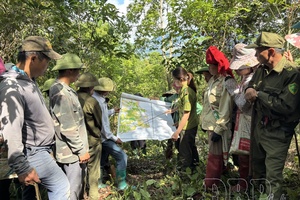
Local communities in Mường Pồn commune accompany rangers during the rainy season to patrol and protect the forest.

Nguyễn Đình Cương, a ranger in Mường Nhé, noted: “Patrolling during the rainy season is extremely strenuous. Many times, when the water levels rise, we have to hang hammocks and sleep in the forest. Sometimes we encounter snakes, leeches, or other insects, and without proper first aid, it can be life-threatening.”

Điện Biên has a total natural area of over 953,000 hectares, of which forest planning covers 592,000 hectares, 62% of the province. With more than 426,000 hectares of forest and complex, rugged mountainous terrain, forest protection here is always an arduous task, especially during the rainy season from June to September. Heavy rains cause floods and landslides in many areas, not only affecting local residents but also seriously hindering forest patrol and management.

Hà Lương Hồng, Director of the Điện Biên provincial Forest Protection Division, said: “Protecting the forest during the rainy season is not just a physical challenge, it’s also a test of climate change resilience. Hotspots are easily exploited by loggers during heavy rains, while travel conditions are extremely difficult.” In response, the department has increased patrol forces, provided specialized rain gear, GPS devices, and headlamps, and coordinated closely with local authorities and village residents to monitor and forecast the activities of violators. Despite facing many dangers, rangers always maintain a steadfast spirit, ready to respond in any weather. However, for more effective and sustainable forest protection, community involvement is crucial, especially from local people, who serve as the forest’s first line of defense.

During the rainy season, in addition to field inspections, forest rangers also use technical equipment and information technology to promptly detect forest violations.

Though protecting the forest during the rainy season is full of hardships, the companionship of local communities empowers the forest rangers. Villagers not only provide information but also directly join patrols to protect the forest. Lò Văn Bình, from Lĩnh hamlet, Mường Pồn commune, shared: “We see the forest as our own property, so we’re always ready to join the rangers in patrols, even in stormy weather. The close bond between villagers and forest rangers has strengthened forest protection efforts and reflects every individual’s sense of responsibility in preserving natural resources.”

The journey to safeguard the forests of Điện Biên is always difficult, especially during the rainy season. Rangers face extreme weather, dangerous terrain, pressure from illegal activities, and resource shortages. Yet with perseverance, unyielding spirit, support from the people, and close direction from the forestry leadership, they continue to overcome challenges and uphold the green mantle of the forest.

Quang Hưng
Comment

You have 500/500 characters left

Please enter 5 or more characters!!!

Recent news

  • 'Helping OCOP producers break into bigger markets

    Helping OCOP producers break into bigger markets

    ECONOMY -
    ĐBP - Markets are expanding, but expectations for products are becoming more demanding. Alongside quality, consumers and distributors are paying closer attention to product origins, production processes, packaging, labeling and the ability to maintain a stable supply.
  • 'Accelerating progress of production development support

    Accelerating progress of production development support

    ECONOMY -
    ĐBP - From the operational capital of national target programs, Điện Biên province is deploying hundreds of production development support projects, contributing to expanding flagship crop zones and generating livelihoods for poor and near-poor households.
  • 'Listening to residents, building consensus in Si Pa Phìn

    Listening to residents, building consensus in Si Pa Phìn

    NEWS - POLITICS -
    ĐBP - From everyday concerns to local policies and initiatives, residents of Si Pa Phìn commune are increasingly able to contribute their opinions, express their aspirations and monitor implementation. By proactively listening, making information public and working together to address legitimate public concerns in a timely manner, local authorities are making grassroots democracy more meaningful and fostering consensus on local development.
  • 'Transmitting heritage through community classes

    Transmitting heritage through community classes

    CULTURE - SPORTS -
    ĐBP - The preservation of cultural heritage in Điện Biên is being carried forward through community classes and daily transmission activities in hamlets and villages. Driven by the dedication of artisans and culture bearers, alongside the proactive spirit of learners, traditional folk songs and dances are transmitted, contributing to safeguarding ethnic identity and ensuring the vitality of heritage within community life.
  • 'Preserving beauty of ethnic minority costumes in Na Sang

    Preserving beauty of ethnic minority costumes in Na Sang

    CULTURE - SPORTS -
    ĐBP - Along with their languages and scripts, the traditional costumes of ethnic minority groups reflect customs, traditions and aesthetic values, while preserving knowledge and skills passed down through generations. In Na Sang commune, efforts to maintain embroidery and tailoring traditions, together with classes teaching traditional pattern-making techniques, are helping preserve the cultural identity of local ethnic communities.
  • 'Nà Hỳ restructures crops

    Nà Hỳ restructures crops

    ECONOMY -
    ĐBP - From swiddens cultivating corn, rice, and cassava on steep land, the people of Nà Hỳ commune are gradually shifting to planting coffee, macadamia, and several perennial industrial crops of high economic value.
  • 'Innovating leadership methods, generating growth momentum

    Innovating leadership methods, generating growth momentum

    ECONOMY -
    ĐBP - Executing the 11.02% growth target for 2026, in the closing months of the year, alongside efficiently exploiting resources, Điện Biên province is focusing on innovating leadership, directing, and administrative methods toward clear objectives, specific solutions, distinct responsibilities, and resolute execution.
  • 'Transparent procurement prices, protecting coffee growers

    Transparent procurement prices, protecting coffee growers

    ECONOMY -
    ĐBP - Faced with the reality that fresh coffee procurement involves multiple focal points and prices between trading spots can fluctuate, local administrations have coordinated with enterprises to maintain daily price transparency, helping farmers proactively choose where to sell and curbing price-squeezing.
  • 'Removing barriers, narrowing gender gap

    Removing barriers, narrowing gender gap

    SOCIAL AFFAIRS -
    ĐBP - Through practical approaches, the Women’s Unions at all levels in the province have recently stepped up communication on gender equality, supporting women in developing livelihoods, creating jobs, and enhancing their capacities.
  • 'Sowing seeds of green agriculture

    Sowing seeds of green agriculture

    ECONOMY -
    ĐBP - Possessing a vast agricultural and forestry land fund alongside diverse, distinctive microclimates, Điện Biên holds substantial headroom to develop green agriculture. From expanding Arabica coffee, macadamia, and fruit tree zones to organic, VietGAP, and high-tech application models, a new direction is steadily taking shape: advancing agriculture not merely by scale, but placing sharper emphasis on quality, value, and sustainability.