



.jpg)
The festival is held around the middle of the eighth lunar month, when people finish harvesting crop.
The Lao ethnic group often lives in different communes in Điện Biên and Điện Biên Đông districts.
In their customs, the New Rice Festival expresses their gratitude to the ancestors and Gods who have blessed and protected their families and clans during the planting and agricultural production.
Since ancient times, when the Lao people's wet rice cultivation was still rudimentary, mainly depending on nature, they believed that a good harvest was protected and bestowed by the Gods.
Therefore, every year after each rice harvest season, they celebrate the New Rice Festival to thank the Gods for the bountiful harvest and welcoming a peaceful new year.
The festival is also a milestone marking the end of a season in which they worked hard and prepare for a new crop.
To get ready for this important festival, one month earlier, representatives of families along with the village chief and shaman will meet to discuss and agree on contributing offerings to the Gods.
They also exchange view on food preparation for the village's communal party.
They assign specific tasks for participants in the festival such as dancing, singing, and playing folk games.
Lao people believe that the fuller the offering tray and the more products it has, the more it shows the fullness and prosperity of the family.
Therefore, the New Rice Festival tray often has white sticky rice, green rice, leaf-fermented rice wine, pork, chicken, duck and other agricultural products.
The tray can also offer natural edible insects including crickets, young bees and bamboo worms.
After the main ceremony, everyone enjoy folk games such as shuttlecock throwing, tug of war, stilt walking, blindfolded while catching duck, turtle hatching eggs, tiger grabbing pig, snake catching young frog and picking ripe melons.
The games are followed by the traditional Lăm Vông dance.
The social development has caused many traditional cultural features in the New Rice Festival of the Lao people to interfere and disappear.
Faced with that risk, in recent years, concerned agencies and local authorities have coordinated with the Lao community in the province to restore the festival.
This is urgent work to preserve and promote the unique cultural values of the Lao people.
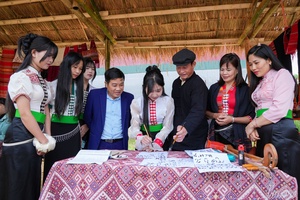
In 2020, the provincial museum presides and coordinates with other agencies to organise the New Rice Festival in Mường Luân Village, Mường Luân Commune in Điện Biên Đông District.
.jpg)
Participating in the festival, Lò Văn Khiến, who resides in Co Kham Village, Mường Luân Commune, expressed, “It has been a long time since I saw a traditional Lao New Rice Festival as complete and ritualistic as this. The restoration was done very well, especially the ritual part with the most unique and meaningful details to the spiritual life and beliefs of Lao people.”
“I feel very satisfied and proud that the traditional culture of the Lao people receives much attention,” added Khiến.
Since then, every year, the Lao people in Mường Luân Commune celebrate the New Rice Festival regularly.
Thereby, they not only contribute to preserving the cultural values but also remind future generations to promote the national cultural identity.
Similarly, in September last year, Điện Biên District organized a program to preserve the traditional New Rice Festival in Pa Xa Lào Village, Pa Thơm Commune.
The purpose of this initiative is to conserve and enhance a traditional festival of the Lao people, serving tourism development associated with new rural lifestyle construction.
This cultural belief has a profound impact on people’s spiritual lives.
The festival’s restoration is also an opportunity for people to strengthen solidarity, overcome all difficulties, and build an increasingly prosperous and happy life together.
The New Rice Festival of the Lao people is a cultural activity that demonstrates their ethic of being grateful to the ancestors and their desire to master nature and their lives.
It guides people towards their future with good things to build an increasingly prosperous life together.
The New Rice Festival of the Lao people holds both historical and cultural value and contributes to attracting researchers and tourists to experience the community's cultural life. — VNS
Thành Đạt
.jpg)
.jpg)
.jpg)
.jpg)
.jpg)
.jpg)
.jpg)
.jpg)
.jpg)
.jpg)
.jpg)
.jpg)
.jpg)
.jpg)
.jpg)
.jpg)
You have 500/500 characters left
Please enter 5 or more characters!!!