Mường Ảng District proposes boosting forest service payments and support

ĐBP – The People's Committee of Mường Ảng District in Điện Biên Province proposed to the National Assembly (NA), Government, and relevant ministries that the payment rate for forest environmental services be doubled and investment and support for production forest planting be tripled.

Specifically, the committee recommended increasing the payment for forest environmental services from VNĐ400,000 to VNĐ800,000 per hectare per year, and raising support for production forest planting from VNĐ5-10 million to VNĐ25-30 million per hectare per year. This aims to encourage residents to develop forest-based economies.

This proposal was presented during a meeting between the People's Committee of Mường Ảng District and a delegation from the National Assembly's Ethnic Council. The meeting discussed the implementation of policies and laws related to land and forest allocation, forest protection and development, and creating stable livelihoods to improve the living conditions of ethnic minority and mountainous communities from 2019 to 2023 in Điện Biên Province.
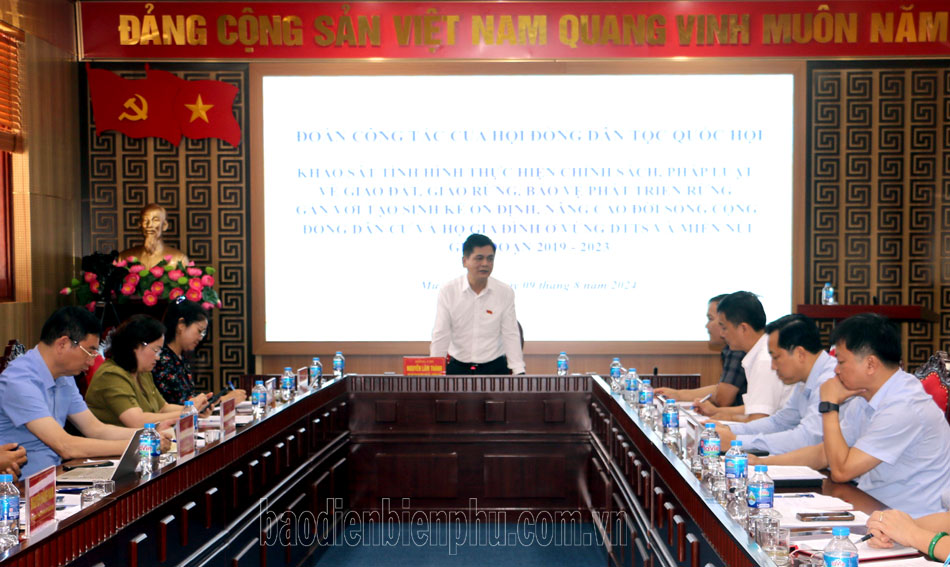
Vice Chairman of the National Assembly's Ethnic Council, Nguyễn Lâm Thành, speaks at a meeting with Mường Ảng District leaders.

From 2019 to 2023, Mường Ảng District planted production and protective forests, as well as alternative protective forests, covering a total area of 576.34 hectares. It supported natural regeneration on over 4,839 hectares and paid forest environmental service fees for 10,494 hectares benefiting 111 households, individuals, and 88 community groups, totaling over VNĐ22 billion.

As of December 31, 2023, over 21,860 hectares of land and forest had been allocated to organisations, community groups, and households in ethnic minority and mountainous areas.

Despite these achievements, the land and forest allocation process has faced challenges. Regulations stipulating that forest land can only be allocated to legally residing individuals in the local communes where the forest is located have made it difficult to encourage and mobilise residents to accept land and forest allocations. Additionally, the support levels for forest protection and development activities are relatively low and have not effectively incentivised community participation.

At the meeting, Mường Ảng District requested that the NA, Government, and relevant ministries consider adjusting certain aspects. Specifically, it proposed that Subprojects 2 and 3 be revised to include support for newly escaped poverty households and those living stably in ethnic minority and mountainous communes. Currently, only poor and near-poor households are eligible for support.

it also requested additional funding for Subproject 2 and Decision No 1719/QD-CP regarding planning, arranging, and stabilising population in necessary areas, to be implemented in the communes of Búng Lao and Nặm Lịch.
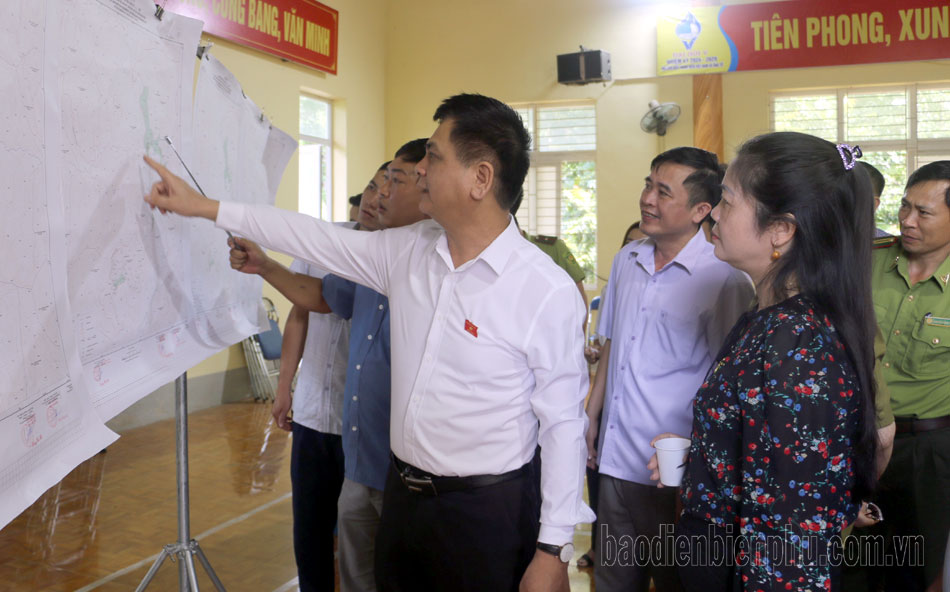
Vice Chairman of the National Assembly's Ethnic Council, Nguyễn Lâm Thành, reviews the land and forest allocation map and land use certificates in Ẳng Tở Commune.

During the meeting, the delegation requested that Mường Ảng District provide the reasons and difficulties in issuing forestry land use certificates, report on the effectiveness of forest-based livelihood models, the payment of support policies for forest planting, and the use of funds for forest environmental service payments by individuals, organisations, and communities.

They also sought information on the management of reclaimed land areas from agricultural and forestry estates, the resolution of overlapping forest areas, and challenges in planting large timber forests.

Previously, the NA's Ethnic Council delegation had conducted a survey on land and forest allocation and the issuance of land use certificates in Ẳng Tở Commune.

By Anh Nguyễn
Comment

You have 500/500 characters left

Please enter 5 or more characters!!!

Recent news

  • 'Beautifying virtue of Uncle Hồ’s soldiers

    Beautifying virtue of Uncle Hồ’s soldiers

    NEWS - POLITICS -
    ĐBP - Heroic and resilient in wartime, pioneering and exemplary in peacetime... are the noble qualities that make up the image of Uncle Hồ’s soldiers. This tradition remains a guiding fire today, helping the young generation arouse the will to strive in studying and training, continuing and promoting the revolutionary tradition of their forefathers in the cause of building and defending the Fatherland.
  • 'Điện Biên leader inspects progress of key projects

    Điện Biên leader inspects progress of key projects

    NEWS - POLITICS -
    ĐBP - On December 18, Lê Văn Lương, Deputy Secretary of the Điện Biên provincial Party Committee, Chairman of the provincial People’s Committee, inspected the implementation progress of the Investment Project to build Si Pa Phìn Inter-level Primary and Secondary School and inspected the Envision Nậm Pồ Wind Power Plant Project and Nậm Pồ 1 Solar Power Plant Project (Si Pa Phìn commune).
  • 'Creative outreach helps forest protection policies take root

    Creative outreach helps forest protection policies take root

    ECONOMY -
    ĐBP - By renewing content and diversifying both target audiences and communication formats, the Điện Biên provincial Forest Protection and Development Fund has played an increasingly important role in spreading forest environmental policies, particularly the policy on payments for forest environmental services (PFES).
  • 'Action for gender equality and safety for girls

    Action for gender equality and safety for girls

    SOCIAL AFFAIRS -
    ĐBP - Recently, the Điện Biên provincial Women’s Union has promoted dissemination, raised awareness, and equipped women with digital skills; simultaneously replicating safe support models and mobilizing the participation of families and the community in implementing gender equality.
  • 'Turning local strengths into growth through crop restructuring

    Turning local strengths into growth through crop restructuring

    ECONOMY -
    ĐBP - Building on its natural strengths in land, climate, and farmers’ production experience, Điện Biên province is stepping up efforts to restructure its agricultural sector, with crop restructuring identified as a key priority. From areas of low efficiency farmland, many localities have proactively shifted to higher value crops better suited to the ecological conditions of each region.
  • 'Ensuring everyone has Tết holiday

    Ensuring everyone has Tết holiday

    SOCIAL AFFAIRS -
    ĐBP - When the 2026 Lunar New Year (Tết) holiday arrives and spring returns, everyone wishes to be warm and well-fed. For the people of the Điện Biên highlands, especially families with difficult circumstances, that desire is multiplied.
  • 'Looking towards National Party Congress with faith and expectation

    Looking towards National Party Congress with faith and expectation

    NEWS - POLITICS -
    ĐBP - In these days, amidst the vibrant atmosphere of labor and production emulation to achieve records welcoming the success of the 15th Điện Biên provincial Party Congress, term 2025 - 2030, officials, party members, and the People of ethnic groups in the province are looking towards the 14th National Party Congress with faith and high expectations for strategic decisions, opening a new development period for the homeland and the country.
  • 'Bringing communal Party Resolutions into life

    Bringing communal Party Resolutions into life

    NEWS - POLITICS -
    ĐBP - Immediately after the First Congress, term 2025 - 2030, commune Party Committees in Điện Biên province quickly implemented resolutions through specific, realistic programs and plans suitable for the conditions of each locality.
  • 'Điện Biên faces difficulty in mobilizing resources for vocational education development

    Điện Biên faces difficulty in mobilizing resources for vocational education development

    SOCIAL AFFAIRS -
    ĐBP - Vocational education plays a key role in building high-quality human resources, meeting socio-economic development requirements. For Điện Biên province, mobilizing resources for vocational education development faces many difficulties; implementation funding depends on the state budget, and socialization sources for investment in vocational education have not yet been mobilized.