Preserving ethnic soul through traditional costumes

ĐBP - Along with language and writing, traditional costumes are a unique cultural feature of the Khơ Mú people. Their multi-colored outfits reflect the diligence, creativity, and meticulousness of Khơ Mú women in every stitch, helping to pass on to the next generation a sense of pride and respect for their cultural roots.

Meticulous and creative in every stitch

In Điện Biên province, the Khơ Mú live in many areas, concentrated in communes such as Tủa Chùa, Quài Tở, Mường Mùn, Mường Chà, Mường Pồn, Phình Giàng, and Mường Nhà. Traditionally, the Khơ Mú did not weave their own fabric but used textiles woven by other ethnic groups to make clothing. Cultural exchange has given Khơ Mú costumes similarities with those of the Thái and Lào, but they still retain distinct identity through delicate techniques of measuring, cutting, sewing, patching, and embroidery.

Artisan Lò Thị Dậu from Huổi Lốt village, Mường Mùn commune, shared: “Our tailoring skills are passed down through experience. At first, people cut fabric directly on the body or from existing clothes. Later, when skilled, they could measure and cut without a sample.”

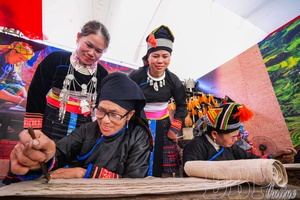
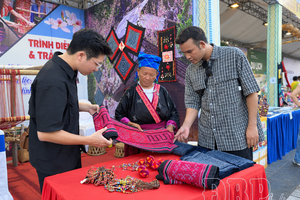
A Khơ Mú artisan introduces traditional costumes.

To complete an outfit, Khơ Mú women hand-sew meticulously using traditional techniques: overcast stitches for softness, running stitches for durability. With only fabric, needle, and thread, they create artistic, identity-rich clothing. A standout technique is patching and piecing brightly colored fabrics to form motifs such as diamonds, peacocks, flowers, and leaves, set against indigo cloth. Embroidery, often with motifs linked to mountains and forests, reflects beliefs and customs, passed down from generation to generation.

For Khơ Mú women, the traditional long skirt is the highlight. Made of cotton dyed indigo, it is plain yet elegant, tied to labor and daily life. The hem is embroidered with colorful motifs symbolizing wishes for prosperity and fertility. A bright blue waistband, 2-2.5m long, completes the outfit, both practical and graceful. The traditional headscarf (hưng pông chưm cưn), about 1.5m long and 30-40cm wide, is carefully embroidered, carrying cultural and aesthetic meaning.

Though modern clothing is often used for work, Khơ Mú people in Điện Biên still keep at least one set of traditional clothes to wear on important occasions. “Whenever we wear our traditional skirts and blouses for festivals or family events, we feel not only more beautiful and confident but also proud of our ethnic culture,” said Lò Thị Khiên of Huổi Lốt village.

Efforts in preservation

Today, the craft of making traditional Khơ Mú costumes is fading, remembered only by some elders. Few families retain traditional-style outfits, and many use industrial fabrics with pre-made patterns instead of handmade embroidery.

To preserve and promote this heritage, the provincial museum partnered with Mường Mùn commune and artisans to open training classes for learners aged 15-50. Under the guidance of skilled artisans, trainees learned every step of making traditional attire. This not only built practical skills but also instilled cultural pride in the younger generation.

Over the course, learners produced 15 complete sets with 54 items. After assessment, 18 pieces were handed to the commune for display and cultural use, while 36 were kept by the museum for research and preservation.

Beyond training, efforts focused on encouraging artisans and learners to become core forces in preservation, passing skills to younger generations. “For the first time, I learned the full process, from measuring and cutting to sewing and embroidery. At first, it was difficult, but with the artisans’ guidance, I managed to make products on my own. I feel proud to help keep and spread Khơ Mú culture and want to teach my children in the future,” shared trainee Lò Thị Mai.

The effort to preserve and teach traditional costume-making not only helps maintain Khơ Mú identity but also fosters pride and responsibility within the community. Each stitch connects past with present and embodies the hope that Khơ Mú culture will continue to shine within the diverse cultural tapestry of Điện Biên’s ethnic groups.

Sầm Phúc
Comment

You have 500/500 characters left

Please enter 5 or more characters!!!

Recent news

  • 'Keeping heritage alive, putting Điện Biên on tourism map

    Keeping heritage alive, putting Điện Biên on tourism map

    TRAVEL -
    ĐBP - In today’s era of integration and development, preserving and promoting cultural heritage must go beyond simply safeguarding the past. Cultural traditions must be transformed into distinctive tourism experiences and recognized as invaluable resources for building a sustainable tourism brand that attracts visitors from Vietnam and abroad.
  • 'Building trust through safer, better school meals

    Building trust through safer, better school meals

    SOCIAL AFFAIRS -
    ĐBP - School meals play an important role in nurturing students, supporting their health and promoting their all-round development. Ensuring the safety and quality of these meals is therefore a priority for schools across Điện Biên province, helping protect students’ health and providing a solid foundation for their learning.
  • 'Standardizing student data in digital environments

    Standardizing student data in digital environments

    SOCIAL AFFAIRS -
    ĐBP - To manage education effectively on digital platforms, it is essential, first and foremost, to possess accurate, complete, and consistent data. In Điện Biên, educational institutions are focusing on reviewing, updating, and synchronizing student information on the sector’s database system.
  • 'Tightening food safety controls

    Tightening food safety controls

    SOCIAL AFFAIRS -
    ĐBP - Food quality is determined from the selection of ingredients and processing to product origin verification. In Điện Biên, production facilities, business establishments, and cooperatives are progressively tightening procedures and heightening responsibility across every phase of production and goods distribution.
  • 'Beyond classrooms: Teaching students to stay safe from fires

    Beyond classrooms: Teaching students to stay safe from fires

    SOCIAL AFFAIRS -
    ĐBP - With potential fire and explosion hazards posing risks at educational institutions, authorities across Điện Biên province are stepping up fire prevention and firefighting efforts through a range of practical activities. By combining awareness campaigns with hands-on demonstrations and skills training, officials, teachers and students are gradually improving their understanding of fire safety and their ability to respond to emergencies, helping create a safer school environment.
  • 'Spreading joy, connecting love

    Spreading joy, connecting love

    SOCIAL AFFAIRS -
    ĐBP - Amid busy work schedules, activities celebrating the Vietnamese Women’s Day on October 20 offer an occasion for women to set aside daily worries, gather, interact, and share life experiences. Each activity carries its own unique character, yet all deliver joy, helping women build confidence and deeply appreciate solidarity and affection in life.
  • 'Điện Biên’s National Assembly deputies contribute opinions to refine laws in healthcare and social welfare

    Điện Biên’s National Assembly deputies contribute opinions to refine laws in healthcare and social welfare

    NEWS - POLITICS -
    ĐBP - On October 21, during the group discussion within the framework of the 2nd Session of the 16th National Assembly, deputies of the Điện Biên provincial National Assembly Deputy Delegation contributed opinions to the draft laws amending and supplementing several articles of the Law on Children, the Law on Persons with Disabilities, the Law on Medical Examination and Treatment, the Law on Pharmacy, the Law on the Elderly, and the Law on Health Insurance.
  • 'Giving residents a voice, turning concerns into action

    Giving residents a voice, turning concerns into action

    NEWS - POLITICS -
    ĐBP - Direct dialogue with residents is a practical way for local authorities to listen to their concerns and aspirations, identify emerging issues in a timely manner, and address problems arising in everyday life. In Mường Pồn commune, dialogue has enabled authorities to hear and consider numerous requests concerning infrastructure, social welfare and agricultural production, assign specific follow-up responsibilities, and strengthen government accountability, public participation and consensus among residents.
  • 'Connecting trade, expanding markets

    Connecting trade, expanding markets

    ECONOMY -
    ĐBP - Under the theme “Điện Biên - A Trade Bridge, Reaching Out to the World,” the 2026 Điện Biên International Trade Fair unlocks opportunities for domestic and international enterprises to connect, promote products, seek business partners, and expand consumer markets.
  • 'People's high consensus clears way for expressway project

    People's high consensus clears way for expressway project

    ECONOMY -
    ĐBP - These days, in Lịch Cang village, Mường Lạn commune, machinery and labor forces are mobilized to level ground, preparing to build a resettlement area serving households affected during the implementation of the Sơn La - Điện Biên - Tây Trang Border Gate Expressway project (Phase 1).
  • 'Điện Biên approves investments totaling VND 7,500 billion

    Điện Biên approves investments totaling VND 7,500 billion

    ECONOMY -
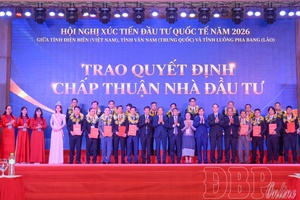
    ĐBP - Marking a fresh stride in regional economic connectivity and cooperation, the 2026 International Investment Promotion Conference between Điện Biên province (Vietnam), Luang Prabang province (Laos), and Yunnan province (China) - held on the morning of October 19 at the Event Center of Mường Thanh Grand Điện Biên Phủ Hotel (Điện Biên Phủ ward), Điện Biên province - opened up opportunities for cooperation and accelerated the harnessing of each locality’s potentials and strengths. At the conference, Điện Biên province presented 20 Investor Approval Decisions with a total investment capital of approximately VND 7,500 billion.